
Co-firing Green Ammonia in Coal-Fired Power Boilers
Chinese
AUG 2024
Policy Brief
CCNT Power
Summary:
This policy brief examines green ammonia co‑firing as a short‑to‑medium‑term coal power decarbonization route requiring only 10% co‑firing capability and minor retrofits; reviews successful industrial pilots (300–630 MW units) now recognized in national energy equipment catalogues; identifies cost and supply barriers—green ammonia remains expensive and scarce, though prices are expected to fall with cheaper renewables and carbon pricing—and recommends prioritizing coal‑heavy, renewables‑rich provinces (Xinjiang, Inner Mongolia, Gansu, Shandong, Shanxi) for scaling.

Related
-
China Carbon Neutrality Tracker 2025 Annual ReportThis report tracks and quantitatively assesses the green and low-carbon transition of 30 Chinese provincial-level regions over the decade from 2013 to 2022 using the Subnational Low-Carbon and Green Index for China (Subnational LOGIC), which encompasses 26 indicators across four categories: carbon productivity; carbon emissions (covering energy, power, industry, buildings, transport, and agriculture); environmental conditions and land use; and policy systems and public participation. The analysis employs multiple classification frameworks—economic-geographic regions, economic development stages (Pioneer, Leading, Catching-Up, and Developing Economies), national major regional strategies, and energy development positioning—to identify structural divergences in transition patterns. It finds that scores improved across all provinces, with carbon productivity, energy, and power showing nationwide progress while transport, buildings, and industry remain key frontiers for deep decarbonization. The report also presents in-depth case studies of Guangdong, Jiangxi, Shanxi, and Hainan to examine differentiated transition pathways across economic development stages.Report JUN 2026
-
2025 Global Coal Phaseout Progress Tracking ReportThis report tracks global coal phaseout progress in 2025, synthesizing key developments across fossil fuel transitions, research findings, just transition policies, green finance, low-carbon industries, and climate governance. It compiles and analyzes information from over 70 news articles, research studies, and policy documents curated through the "Farewell Coal" project, presenting country-specific case studies (including Vietnam, the EU, Finland, Ireland, the US, the Philippines, and Poland), regional analyses (OECD countries, Southeast Asia, South Asia, and Africa), and thematic assessments of renewable energy growth, carbon pricing, and the political economy of coal exit. The report provides a comprehensive overview of the structural trends shaping the global shift away from coal.Report MAR 2026
-
Provincial “15th Five-Year Plan” Recommendations: Dual-Carbon KeywordsThis policy brief analyzes the green and low-carbon development content in provincial-level recommendations for China's 15th Five-Year Plan (2026–2030). It systematically reviews 30 provincial documents to identify key "dual-carbon" (carbon peaking and carbon neutrality) priorities, including carbon peaking timelines, carbon emissions dual-control systems, new energy system construction, sectoral transitions (industry, transport, buildings, agriculture), and the deployment of zero-carbon parks, zero-carbon factories, and climate adaptation measures. The analysis is based on a systematic review and comparative analysis of provincial policy texts, categorizing and quantifying the frequency and content of policy keywords to identify regional patterns, alignment with national priorities, and local-level implementation focuses.Policy Brief FEB 2026
-
Understanding the “Dual Carbon” Key Terms in Provincial “15th Five-Year Plan” ProposalsAs of January 2026, a total of 30 provincial-level administrative regions in China had released the full text of their “15th Five-Year Plan” proposals. iGDP found that while the policy statements regarding the priorities of green transition in each province showed a high degree of alignment with the national “15th Five-Year Plan” proposal, they also featured notable local highlights.Op-ed FEB 2026

-
Zero-Carbon Park Development: From Local Exploration to Nationwide Systematic PlanningThis policy brief examines the development of zero-carbon parks in China, analyzing the transition from fragmented local experimentation to nationally coordinated planning. It reviews the policy landscape and standard-setting landscape, categorizing standards into three types (group standards, local standards, and provincial action plans). It then identifies three differentiated regional development models based on analysis of 80 zero-carbon park pilots across eight provinces: emerging industry-driven (eastern coastal regions), clean energy-driven (southwestern regions), and energy transition-driven (central regions). The analysis also synthesizes the multi-dimensional characteristics of park development—energy, industry, transport, buildings, ecology, resource cycling, carbon management, and carbon sinks—and discusses the implications of the July 2025 national policy that formalized zero-carbon park development at the central government level.Working Paper DEC 2025

-
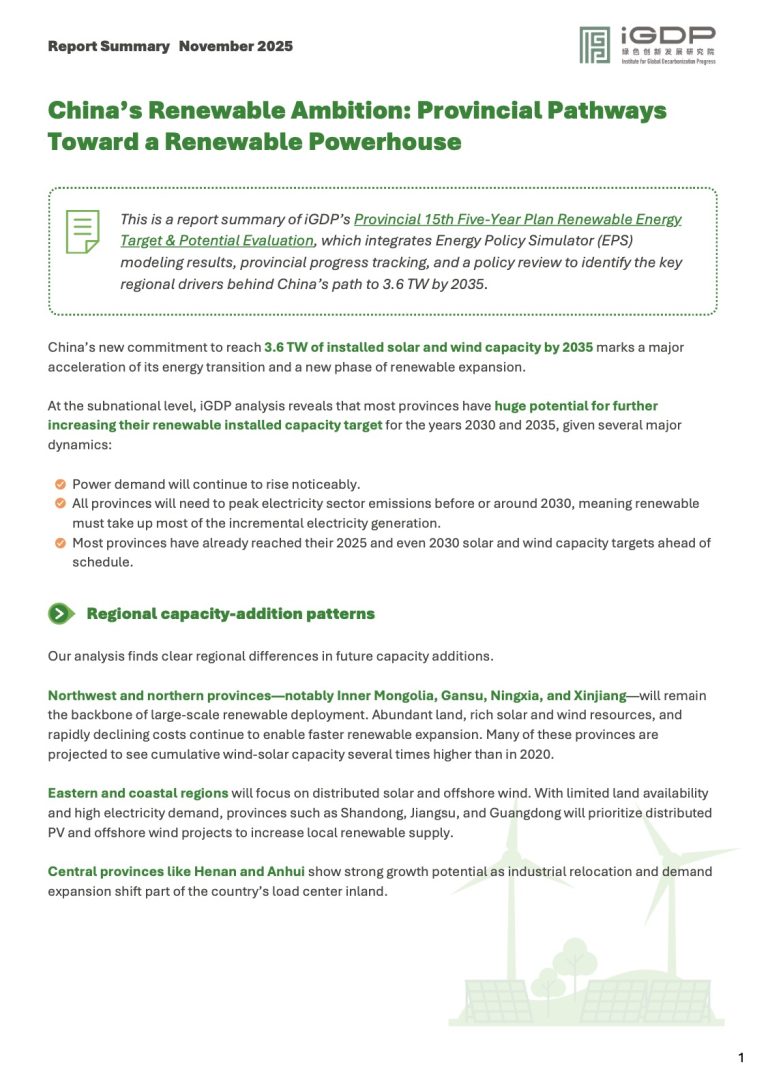
China’s Renewable Ambition: Provincial Pathways Toward a Renewable PowerhouseThis report analyzes provincial-level pathways for achieving China's national target of 3.6 TW of installed solar and wind capacity by 2035. It integrates EPS 30-province modeling results, provincial renewable target tracking, and policy review to identify key regional drivers. It projects solar and wind capacity additions under a Dual Carbon Scenario, compares these projections against existing provincial targets (many of which have already been met years ahead of schedule), and analyzes electricity demand growth patterns to identify supply-demand imbalances. It finds that ten provinces—led by Inner Mongolia, Shandong, Jiangsu, Henan, and Guangdong—will account for over half of capacity additions, with solar PV dominating growth. The analysis highlights the critical enabling roles of transmission infrastructure and electricity market reform in sustaining rapid renewable expansion.Report Summary NOV 2025