
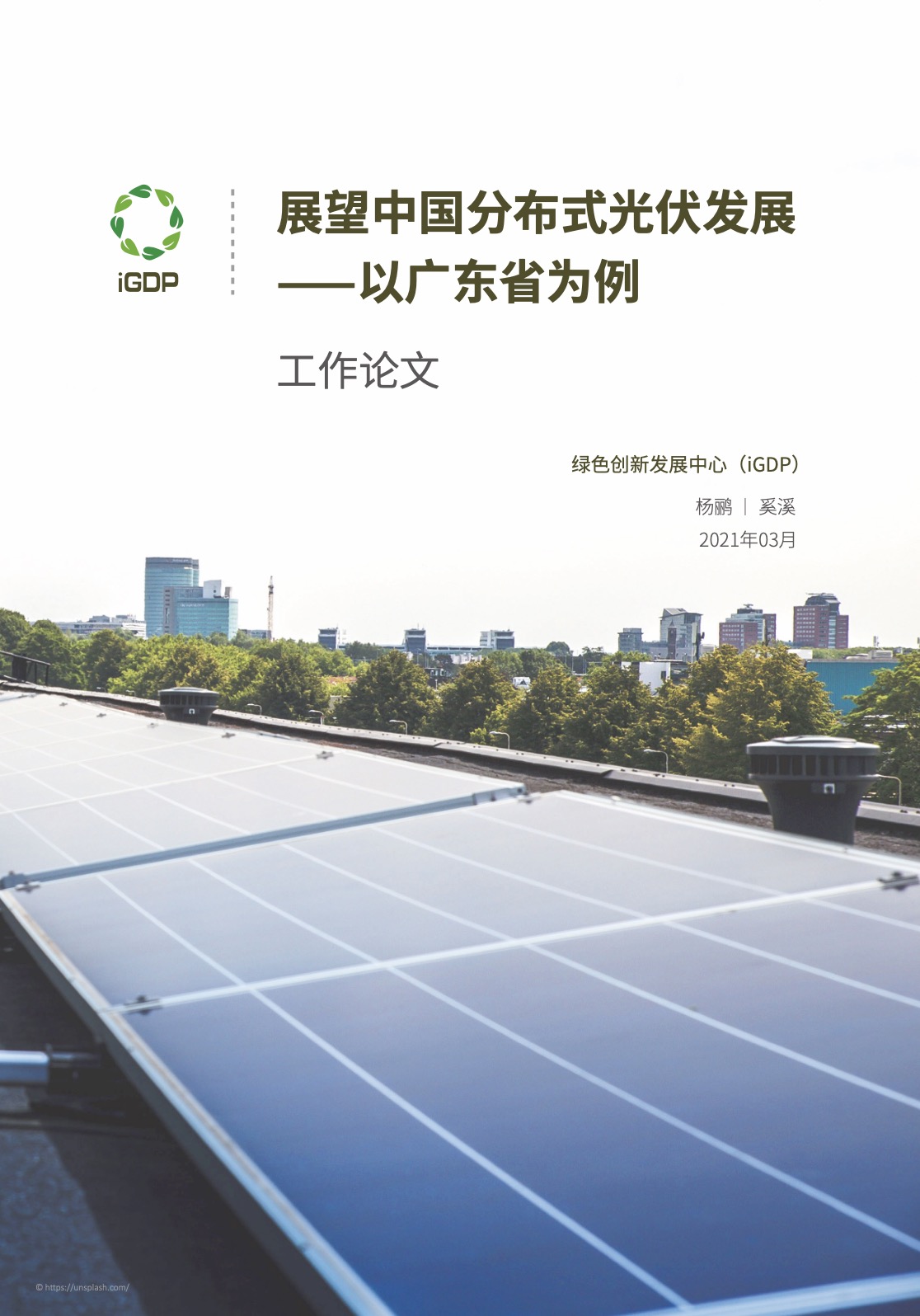
Outlook for China's Distributed Photovoltaic Development in Guangdong
Chinese
MAR 2021
Working Paper
Power Subnational Climate Action
Summary:
This working paper examines the development of distributed photovoltaic power in Guangdong Province, analyzing current trends, challenges, and future opportunities. Based on field research and interviews with local experts, the report identifies that while Guangdong has significant rooftop resources and favorable economic conditions for distributed PV development, growth has slowed due to unclear business models and financing difficulties, particularly for small commercial and residential installations. The paper recommends innovative financing mechanisms, carbon finance integration, and supportive policy environments to unlock Guangdong's distributed PV potential.
Suggested citation:
Yang Peng, Xi Xi. (2021). Outlook for China's Distributed Photovoltaic Development in Guangdong. Beijing: Institute for Global Decarbonization Progress (iGDP).
Related
-
Green Power Consumption Faces New ChallengesWith the rapid growth in installed capacity, the core challenge facing the power system is shifting from “whether we can generate more green electricity” to “whether we can effectively utilize green electricity at the right time and place.”Interview JUL 2026

-
iGDP’s Hu Min: How Can We “Access” and “Effectively Utilize” Green Power?The 2026 Summer Davos Forum (the 17th Annual Meeting of the World Economic Forum’s New Champions) recently concluded in Dalian, Liaoning. With “Scaling Innovation” as its theme, the forum brought together more than 1,700 delegates from over 90 countries and regions to discuss five core topics.Interview JUL 2026

-
When Computing Power Starts Competing for Electricity: Why Can Companies Not Access Green Power?AI is driving a new wave of computing infrastructure development and has brought electricity demand to the forefront of industry competition. A seemingly contradictory phenomenon is that while China’s installed capacity of renewable energy is growing rapidly, companies still do not have enough green electricity available.Interview JUL 2026

-
China Carbon Neutrality Tracker 2025 Annual ReportThis report tracks and quantitatively assesses the green and low-carbon transition of 30 Chinese provincial-level regions over the decade from 2013 to 2022 using the Subnational Low-Carbon and Green Index for China (Subnational LOGIC), which encompasses 26 indicators across four categories: carbon productivity; carbon emissions (covering energy, power, industry, buildings, transport, and agriculture); environmental conditions and land use; and policy systems and public participation. The analysis employs multiple classification frameworks—economic-geographic regions, economic development stages (Pioneer, Leading, Catching-Up, and Developing Economies), national major regional strategies, and energy development positioning—to identify structural divergences in transition patterns. It finds that scores improved across all provinces, with carbon productivity, energy, and power showing nationwide progress while transport, buildings, and industry remain key frontiers for deep decarbonization. The report also presents in-depth case studies of Guangdong, Jiangxi, Shanxi, and Hainan to examine differentiated transition pathways across economic development stages.Report JUN 2026
-
Hainan’s Model for Promoting the Adoption of Battery-Swap Heavy-Duty TrucksHainan has built and put into operation 37 battery-swapping stations for heavy-duty trucks, providing basic coverage of the island’s main highways and key industrial parks, thereby effectively advancing the transition of new-energy heavy-duty trucks from pilot projects in typical application scenarios to full-scale electrification across the region.Op-ed MAY 2026
-
Medium and Long-Term Outlook for Low-Carbon Transition in Tianjin Using EPS ModelingThis report assesses the low-carbon transition pathway for Tianjin Municipality under China's carbon peaking and carbon neutrality goals, using the Energy Policy Simulator (EPS) model to quantify energy consumption and greenhouse gas emission trajectories to 2060. It employs a scenario-based quantitative modeling framework, constructing three scenarios—a 2020 Policy Freeze scenario, a Policy scenario, and a Dual Carbon scenario—to evaluate the emission reduction effects of different policy combinations. The EPS Tianjin 2024 model covers five core sectors: power, industry, transport, buildings, and land use and forestry, capturing inter-sectoral linkages and mitigation potentials. The analysis identifies critical areas and priority policies for achieving carbon neutrality, assesses investment requirements, and evaluates the economic and employment impacts of the transition.Report Summary APR 2026