Introducing an Absolute Carbon Cap into China's Five Year Plan
English
JUN 2019
Report
CCNT Climate Governance
Summary:
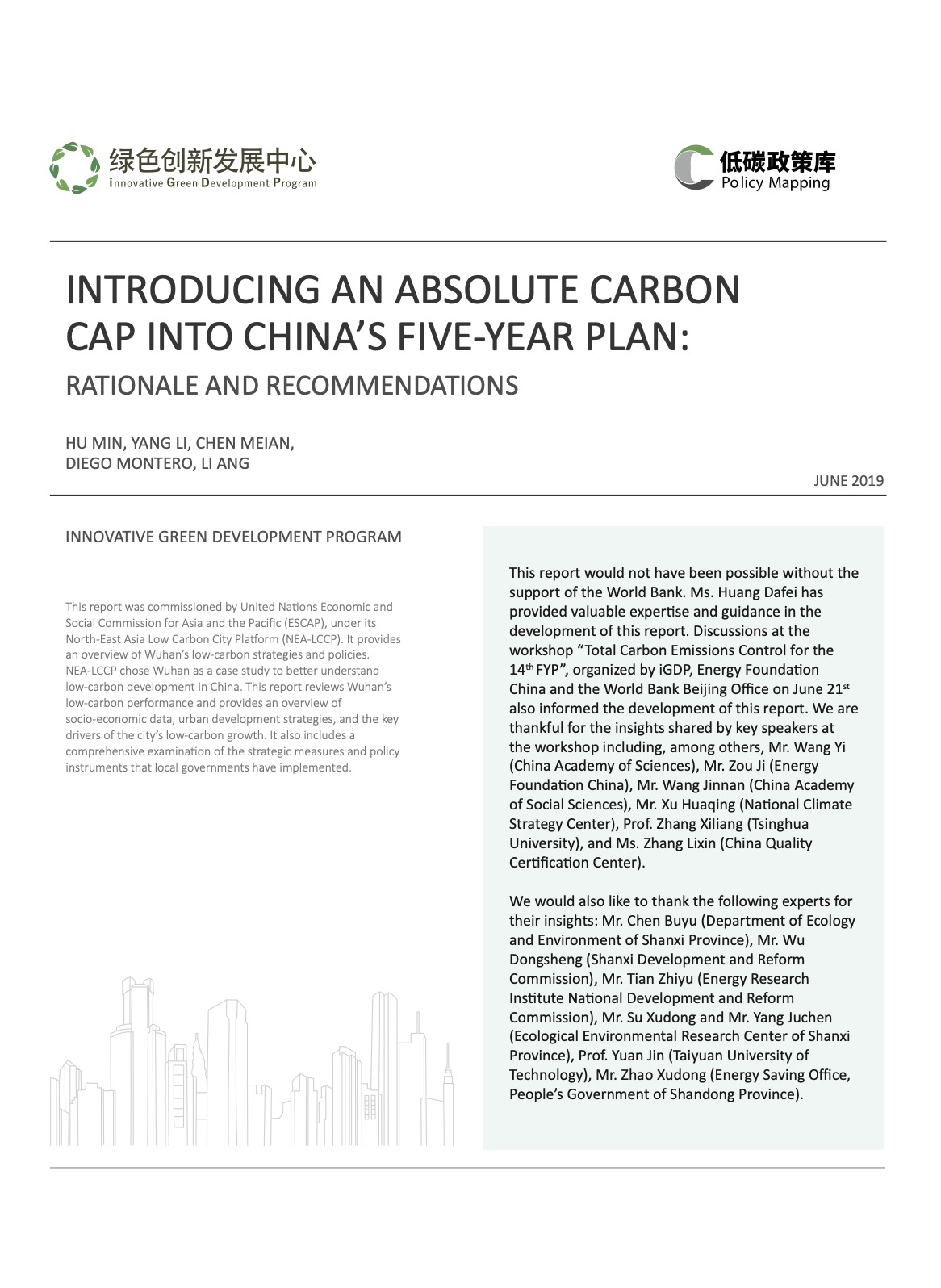
This report makes the case for introducing an absolute carbon cap into China's 14th Five-Year Plan as an enhanced climate policy measure. It argues that while China has made progress on carbon intensity reduction, absolute emissions continue to rise, and an economy-wide carbon cap would provide clearer policy signals, facilitate carbon peaking, and align with the Ministry of Ecology and Environment's emissions control governance. The report examines international precedents, China's feasibility for implementing such a cap, and provides recommendations on design elements including legal basis, regional differentiation, integration with the national carbon market, and leveraging complementary policy actions.
Suggested citation:
Hu Min, Yang Li, Chen Meian, Diego Montero, Li Ang. (2019). Introducing an Absolute Carbon Cap into China's Five-Year Plan: Rationale and Recommendations. Beijing: Institute for Global Decarbonization Progress (iGDP).
Related
-
China’s New Carbon-Intensity Measure Has Not Changed Its Climate PledgesExpanding carbon intensity to include industrial process emissions strengthens longer-term decarbonization, argue Hu Min, Li Xindi, and Yang Li.Op-ed AUG 2026
-
China Carbon Neutrality Tracker 2025 Annual ReportThis report tracks and quantitatively assesses the green and low-carbon transition of 30 Chinese provincial-level regions over the decade from 2013 to 2022 using the Subnational Low-Carbon and Green Index for China (Subnational LOGIC), which encompasses 26 indicators across four categories: carbon productivity; carbon emissions (covering energy, power, industry, buildings, transport, and agriculture); environmental conditions and land use; and policy systems and public participation. The analysis employs multiple classification frameworks—economic-geographic regions, economic development stages (Pioneer, Leading, Catching-Up, and Developing Economies), national major regional strategies, and energy development positioning—to identify structural divergences in transition patterns. It finds that scores improved across all provinces, with carbon productivity, energy, and power showing nationwide progress while transport, buildings, and industry remain key frontiers for deep decarbonization. The report also presents in-depth case studies of Guangdong, Jiangxi, Shanxi, and Hainan to examine differentiated transition pathways across economic development stages.Report JUN 2026

-
Provincial “15th Five-Year Plan” Recommendations: Dual-Carbon KeywordsThis policy brief analyzes the green and low-carbon development content in provincial-level recommendations for China's 15th Five-Year Plan (2026–2030). It systematically reviews 30 provincial documents to identify key "dual-carbon" (carbon peaking and carbon neutrality) priorities, including carbon peaking timelines, carbon emissions dual-control systems, new energy system construction, sectoral transitions (industry, transport, buildings, agriculture), and the deployment of zero-carbon parks, zero-carbon factories, and climate adaptation measures. The analysis is based on a systematic review and comparative analysis of provincial policy texts, categorizing and quantifying the frequency and content of policy keywords to identify regional patterns, alignment with national priorities, and local-level implementation focuses.Policy Brief FEB 2026

-
Understanding the “Dual Carbon” Key Terms in Provincial “15th Five-Year Plan” ProposalsAs of January 2026, a total of 30 provincial-level administrative regions in China had released the full text of their “15th Five-Year Plan” proposals. iGDP found that while the policy statements regarding the priorities of green transition in each province showed a high degree of alignment with the national “15th Five-Year Plan” proposal, they also featured notable local highlights.Op-ed FEB 2026

-
Zero-Carbon Park Development: From Local Exploration to Nationwide Systematic PlanningThis policy brief examines the development of zero-carbon parks in China, analyzing the transition from fragmented local experimentation to nationally coordinated planning. It reviews the policy landscape and standard-setting landscape, categorizing standards into three types (group standards, local standards, and provincial action plans). It then identifies three differentiated regional development models based on analysis of 80 zero-carbon park pilots across eight provinces: emerging industry-driven (eastern coastal regions), clean energy-driven (southwestern regions), and energy transition-driven (central regions). The analysis also synthesizes the multi-dimensional characteristics of park development—energy, industry, transport, buildings, ecology, resource cycling, carbon management, and carbon sinks—and discusses the implications of the July 2025 national policy that formalized zero-carbon park development at the central government level.Working Paper DEC 2025

-
From Concept to ActionChina is offering other Global South countries a viable way to discover a just transition pathway of their own.Op-ed DEC 2025