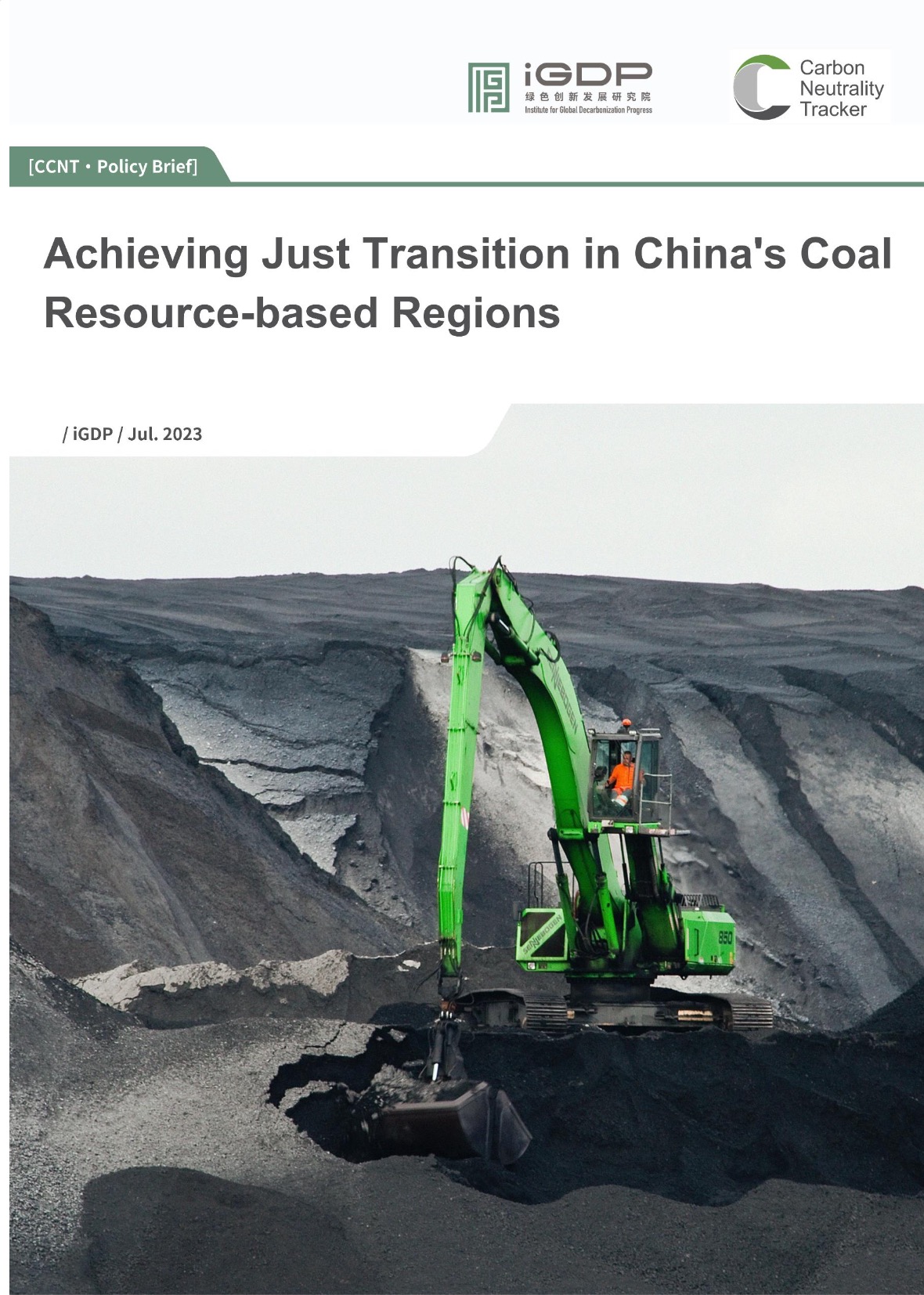
Achieving Just Transition in China's Coal Resource-Based Regions
English, Chinese
JUL 2023
Policy Brief
CCNT Just Transition Subnational Climate Action
Summary:
This policy brief examines the challenges and pathways for achieving a just transition in China's coal-dependent regions as the country pursues its dual carbon goals. It focuses on four critical dimensions that require coordinated action: fostering high-quality economic development through industrial diversification, safeguarding livelihoods and employment security for coal workers and vulnerable communities, managing the phased reduction of coal production while maintaining energy supply stability, and strengthening environmental restoration in mining areas. The policy brief draws on domestic and international experiences to outline a dual-stage transition strategy—first upgrading existing coal operations with smarter and cleaner technologies, then leveraging regional resources to cultivate renewable energy and complementary green industries. It also stresses the importance of robust social safety nets, worker retraining programs, and ecological rehabilitation measures such as repurposing abandoned mining lands for clean energy projects and carbon sinks. The policy brief argues that proactive planning, dynamic capacity adjustment mechanisms, and integrated multi-energy supply systems are essential to mitigate the socioeconomic and environmental impacts of the coal industry's decline, ensuring that the transition is both equitable and sustainable.
Suggested citation:
Yang Li. (2023). Achieving Just Transition in China's Coal Resource-based Regions. Report. Beijing: Institute for Global Decarbonization Progress (iGDP).
Related
-
Accelerating Green and Just Transition in the Global SouthThis paper argues that just transition (JT) frameworks built for developed economies don't fit the realities of the Global South — where the challenge isn't just managing the decline of fossil fuel industries, but industrializing, expanding energy access, and reducing poverty while also decarbonizing. The paper reviews major existing JT frameworks (UNFCCC, EU, G20, China, Brazil) and analyzes the climate plans (NDCs) and transparency reports of 66 developing countries to see how JT is actually being defined and pursued on the ground. From this, it builds a new evaluation framework organized around three pillars — Goals (where countries want to end up, climate and development-wise), Pathways (how they're getting there, e.g. green jobs, investment, industries), and Readiness and Capacity (whether they have the social safety nets, finance, and institutions to pull it off) — then tested this framework against real country data to show it can help identify gaps and guide more tailored, country-led policy.Academic Journal Article JUN 2026

-
China Carbon Neutrality Tracker 2025 Annual ReportThis report tracks and quantitatively assesses the green and low-carbon transition of 30 Chinese provincial-level regions over the decade from 2013 to 2022 using the Subnational Low-Carbon and Green Index for China (Subnational LOGIC), which encompasses 26 indicators across four categories: carbon productivity; carbon emissions (covering energy, power, industry, buildings, transport, and agriculture); environmental conditions and land use; and policy systems and public participation. The analysis employs multiple classification frameworks—economic-geographic regions, economic development stages (Pioneer, Leading, Catching-Up, and Developing Economies), national major regional strategies, and energy development positioning—to identify structural divergences in transition patterns. It finds that scores improved across all provinces, with carbon productivity, energy, and power showing nationwide progress while transport, buildings, and industry remain key frontiers for deep decarbonization. The report also presents in-depth case studies of Guangdong, Jiangxi, Shanxi, and Hainan to examine differentiated transition pathways across economic development stages.Report JUN 2026

-
Hainan’s Model for Promoting the Adoption of Battery-Swap Heavy-Duty TrucksHainan has built and put into operation 37 battery-swapping stations for heavy-duty trucks, providing basic coverage of the island’s main highways and key industrial parks, thereby effectively advancing the transition of new-energy heavy-duty trucks from pilot projects in typical application scenarios to full-scale electrification across the region.Op-ed MAY 2026

-
Medium and Long Term Outlook for Low Carbon Transition in Tianjin Using EPS ModelingThis report assesses the low-carbon transition pathway for Tianjin Municipality under China's carbon peaking and carbon neutrality goals, using the Energy Policy Simulator (EPS) model to quantify energy consumption and greenhouse gas emission trajectories to 2060. The methodology employs a scenario-based quantitative modeling framework, constructing three scenarios—a 2020 Policy Freeze scenario, a Policy scenario, and a Dual Carbon scenario—to evaluate the emission reduction effects of different policy combinations. The EPS Tianjin 2024 model covers five core sectors: power, industry, transport, buildings, and land use and forestry, capturing inter-sectoral linkages and mitigation potentials. The analysis identifies critical areas and priority policies for achieving carbon neutrality, assesses investment requirements, and evaluates the economic and employment impacts of the transition.Report Summary APR 2026

-
Provincial “15th Five-Year Plan” Recommendations: Dual-Carbon KeywordsThis policy brief analyzes the green and low-carbon development content in provincial-level recommendations for China's 15th Five-Year Plan (2026–2030). It systematically reviews 30 provincial documents to identify key "dual-carbon" (carbon peaking and carbon neutrality) priorities, including carbon peaking timelines, carbon emissions dual-control systems, new energy system construction, sectoral transitions (industry, transport, buildings, agriculture), and the deployment of zero-carbon parks, zero-carbon factories, and climate adaptation measures. The analysis is based on a systematic review and comparative analysis of provincial policy texts, categorizing and quantifying the frequency and content of policy keywords to identify regional patterns, alignment with national priorities, and local-level implementation focuses.Policy Brief FEB 2026

-
Understanding the “Dual Carbon” Key Terms in Provincial “15th Five-Year Plan” ProposalsAs of January 2026, a total of 30 provincial-level administrative regions in China had released the full text of their “15th Five-Year Plan” proposals. iGDP found that while the policy statements regarding the priorities of green transition in each province showed a high degree of alignment with the national “15th Five-Year Plan” proposal, they also featured notable local highlights.Op-ed FEB 2026