

June 25, 2026
Beijing
The seminar was jointly organized by Agora Energy China and the Institute for Institute for Global Decarbonization Progress (iGDP). Focusing on three emerging energy consumption scenarios—zero-carbon parks, green electricity direct connection, and coordinated development of computing power and energy—the seminar explored key policies and market mechanisms to facilitate green power consumption, providing insights and recommendations for promoting the high-quality development of renewable energy.
-
 Climate Catalyst: From “Old Houses” to “Good Homes” — Seminar on Low-Carbon Renovation of Existing BuildingsPast event APR 2026
 -
 Climate Catalyst × Tiangong Academic Salon — Green Fuels and Emission Reduction in China’s Transport Sector: Application Pathways and Industrial DevelopmentPast event JAN 2026
01 Opening Remarks
Tu Jianjun, President of Agora Energy China, noted in his opening remarks that 2026 is a strategically critical year for China’s electricity sector reforms. With the rapid rise of distributed energy, flexible loads, and new types of market participants, China’s power system is undergoing a comprehensive transition from the traditional centralized power supply model toward a new power system characterized by greater diversification, decentralization, and market orientation. He emphasized that Document No. 688, jointly issued by the National Development and Reform Commission (NDRC) and the National Energy Administration (NEA) in May this year, established a clear policy direction for multi-user green electricity direct connection, identifying industrial parks and green data centers as high-potential application scenarios. Green electricity direct connection is therefore moving from the pilot stage toward nationwide large-scale deployment.
The industry’s key bottlenecks have now shifted from technological implementation to institutional governance, with three major challenges remaining: first, the lack of unified national standards and technical specifications; second, poor integration between emerging business models and existing market mechanisms; and third, regulatory and governance capabilities lagging behind the pace of industrial innovation. He called on all stakeholders to focus on top-level policy design and the development of long-term market mechanisms, so as to transform innovative practices from fragmented pilot projects into replicable, scalable, and sustainable market mechanisms.
02 Keynote Presentations
Wang Yongli, Deputy Director of the Energy Internet Research Center at North China Electric Power University, delivered a presentation titled Research Directions for Coordinated Development of Computing Power and Electricity. From the perspectives of the underlying logic of energy evolution, top-level policy orientation, the flexible characteristics of computing loads, and planning and operational technologies, he systematically analyzed the development opportunities, core mechanisms, and implementation pathways for the deep integration of computing power and electricity.
He noted that policy priorities have shifted from simply ensuring the development of computing infrastructure toward improving the quality of green computing power. Through measures such as greater use of green electricity, energy efficiency constraints, and market-based allocation mechanisms, policymakers are guiding computing centers to reduce energy consumption and improve the capacity to absorb clean energy. Compared with traditional industrial loads, computing centers are highly digitalized and software-defined, enabling them to flexibly manage real-time responsive loads, highly concurrent online loads, long-duration and high-intensity computing loads, and opportunity-based flexible tasks. In terms of implementation, the three pathways of green electricity direct connection, integrated wind-solar-storage dispatch, and market-based electricity trading can transform computing centers from conventional electricity loads into new types of market participants capable of generating value from demand-side flexibility.
Shao Guiping, Deputy Secretary-General of the Specialized Committee on Integrated Energy Systems of the Chinese Renewable Energy Engineering Institute, delivered a presentation titled Opportunities and Challenges in the Development of Zero-Carbon Parks. She proposed that the future energy system should be centered on wind and solar power, supported by coordinated utilization of electricity, heat, and hydrogen, with fossil fuels gradually shifting toward non-energy uses.
The core principle of zero-carbon park development is to prioritize internal emission reductions, supplemented by external offsets. Integrated planning of energy sources, grids, loads, and storage during the planning stage determines the long-term ceiling for cost and carbon reductions in industrial parks. Key challenges in practice include long investment payback periods, insufficient willingness among enterprises to participate, and significant barriers to cross-departmental coordination. Drawing on leading cases in China and abroad, she proposed three approaches to breaking through these bottlenecks: first, coordinate loads and distributed resources across the entire park; second, develop an integrated micro-energy network for the park; and third, establish a dual symbiotic closed loop integrating energy and material ecosystems.
Wang Shujuan, an expert from the Investment and Energy Committee of the China Investment Association, delivered a presentation titled Policy Analysis and Outlook for Green Electricity Direct Connection Projects, providing a systematic analysis of industry prospects and policy trends in the context of two major application scenarios: coordinated development of computing power and electricity and zero-carbon parks.
She noted that the logic underpinning new energy development during the 15th Five-Year Plan period will undergo a fundamental shift. The scale of projects traditionally relying on the large power grid for electricity consumption will continue to contract, while green electricity direct connection projects based on nearby development and self-generation for self-consumption, as well as source-grid-load-storage microgrids, will become mainstream.
From the perspective of policy evolution, Document No. 650 established the basic framework for green electricity direct connection; Document No. 1,192 clarified the rules for transmission and distribution tariff collection; and Document No. 688 promoted the development of multi-user green electricity direct connection, allowing one-to-many and many-to-many operations and enabling hourly matching and traceability of electricity consumption. These developments significantly reduce the operational risks associated with single-user projects and substantially expand the scope of potential project applications.
03 Roundtable Discussion
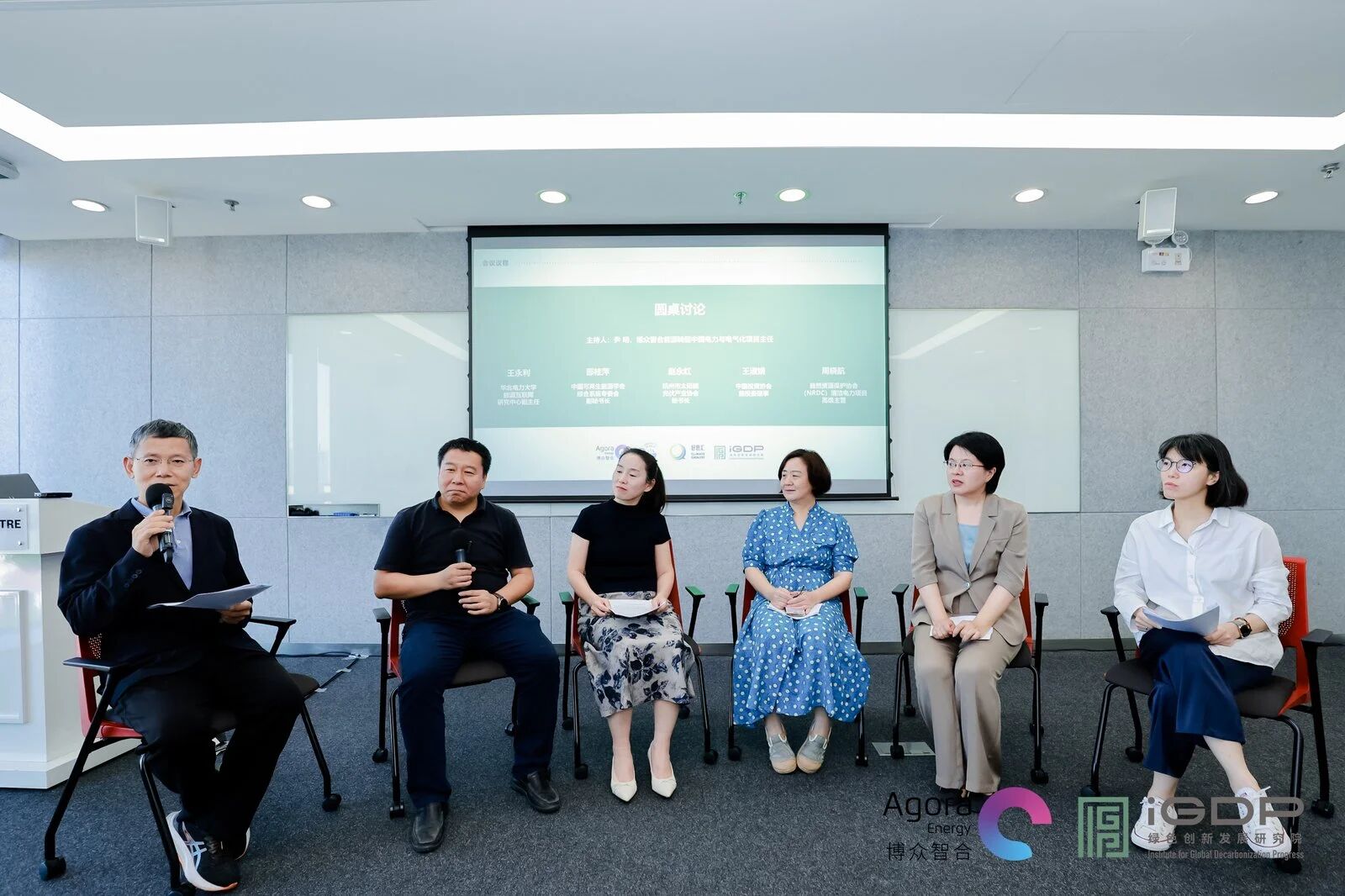
Moderated by Yin Ming, Director of the Electricity and Electrification Project at Agora Energy China, the roundtable brought together five experts—Shao Guiping, Wang Shujuan, Wang Yongli, Zhao Yonghong, Secretary-General of the Hangzhou Solar Photovoltaic Industry Association, and Zhou Xiaohang, Senior Manager for Clean Electricity at the Natural Resources Defense Council (NRDC). The experts engaged in an in-depth discussion on emerging energy-use scenarios, examining opportunities, bottlenecks, and long-term solutions for green electricity consumption from multiple perspectives, including top-level policy design, local implementation, industry economics, and market mechanism innovation.
Wang Yongli discussed the matching logic between computing power and renewable energy as well as the rules for coordinated dispatch of computing power and electricity. He noted that energy storage and the power grid serve as key intermediaries for matching computing centers with renewable energy. Computing centers can use stored green electricity, while during periods of peak electricity demand, they can also feed green electricity back to power grid companies, enabling two-way interaction. Coordinated development of computing power and electricity requires a two-level dispatch framework covering both planning and operations. At the planning level, wind, solar, and energy storage resources should be configured in an integrated manner, while idle power supply equipment in data centers can be brought into grid peak regulation to generate additional revenue. During operations, computing loads should be managed across multiple time periods, with algorithms used to develop standardized coordinated dispatch mechanisms.
Wang Shujuan focused on how green electricity direct connection is reshaping regional industrial competitiveness. She pointed out that zero-carbon parks are important platforms for provinces to achieve carbon reduction, while green electricity direct connection has become a key differentiating advantage in local investment promotion and business attraction. It can help enterprises respond to the EU Carbon Border Adjustment Mechanism (CBAM) and meet the green supplier access requirements of centrally administered state-owned enterprises.
Shao Guiping shared her views on the nature of zero-carbon parks and the integration of resources. She noted that integrated energy service providers in industrial parks perform three functions: ensuring energy supply, providing public services, and conducting market-oriented operations. They could therefore be granted a quasi-utility status to coordinate the boundary between industrial parks and the power grid. For distributed and flexible resources within parks, such as photovoltaic power and energy storage, two models can be adopted: lightweight asset aggregation and operation, and unified development of heavyweight assets. A unified operations platform can then be used to balance the interests of different stakeholders.
Zhao Yonghong noted that industrial parks on the front lines of implementation generally face the challenge of temporal and spatial mismatches between electricity generation and consumption. In some parks, investment promotion has fallen short of expectations, resulting in an uneven distribution of electricity demand within the parks.
Taking Linping Development Zone, which has one of the highest photovoltaic installation densities, as an example, the region has substantial photovoltaic capacity, but the proportion of green electricity actually consumed by most enterprises remains below 10%. She proposed that real-time balancing between electricity generation and consumption is critical to the stable operation of industrial parks and the power grid. The local government is currently exploring the implementation of an “ubiquitous zero-carbon power system” solution tailored to local conditions to effectively alleviate pressure on grid-based renewable energy consumption.
Zhou Xiaohang focused on the commercialization bottlenecks of V2G mobile energy storage. Electric vehicles are distributed flexibility resources with extremely low marginal costs, but unclear accounting of battery degradation costs and revenues and a lack of effective incentive mechanisms remain key barriers to large-scale deployment. She proposed balancing the interests of vehicle owners, automakers, and power grid companies through measures such as developing high-cycle-life batteries specifically designed for V2G applications, providing insurance against battery degradation, and using market-based flexibility revenues to offset depreciation costs. In addition, electric vehicles have unique advantages as mobile, distributed, and flexible resources and can effectively address imbalances in distribution-grid loads. As the penetration rate of new energy vehicles continues to rise, the enormous number of vehicles will form a sizable distributed energy storage resource.
04 Conclusion
Yang Li, Deputy Director of the Institute for Global Decarbonization Progress (iGDP), delivered the concluding remarks and systematically summarized the outcomes of discussions around three emerging application scenarios: coordinated development of computing power and electricity, zero-carbon parks, and green electricity direct connection.
First, computing power should not be viewed solely as a high-energy-consuming load; its value as a flexible resource should also be explored. Different types of computing loads have significantly different flexibility potential. The scale and temporal and spatial distribution of flexible loads nationwide represent an important area for further research on the demand side.
Second, zero-carbon parks provide a core spatial platform for the deployment of various green electricity models, including microgrids, green electricity direct connection, source-grid-load-storage integration, and virtual power plants. However, mature implementation cases that can deliver stable economic returns remain relatively scarce. In addition, the zero-carbon transformation of industrial parks with high heat demand, such as those for steel, chemicals, and building materials, should also be a key area for future research.
Third, the costs of green electricity direct connection projects include multiple expenditures, such as dedicated lines and dedicated transformers, supporting energy storage, system operation, and capacity and demand charges. Due to differences in industrial structures, average load factors, and electricity market rules across provinces, project profitability varies significantly from region to region. The differentiated economics of projects across regions therefore warrant continued and in-depth research.
About Agora Energy China
Agora Energy China was established in 2021 and is committed to developing scientifically sound and feasible proposals to advance the clean energy transition and net-zero emissions in China and globally. Its key research areas include the transformation of clean power systems, industrial decarbonization, and regional energy transitions. At the same time, Agora Energy China actively conducts capacity building to strengthen the research and practical capabilities of professionals in relevant fields and promote the carbon neutrality transition of China’s state-owned energy enterprises. Drawing on the extensive expertise of its research team and broad network of partners, Agora Energy China provides recommendations to policymakers and facilitates effective communication and cooperation among relevant stakeholders.
The transition from fossil fuels to renewable energy and ultimately to net-zero emissions is a complex process that no single organization can address independently. Against this backdrop, Agora Energy China engages in in-depth dialogue with partners from government agencies, civil society organizations, businesses, and research institutions, while actively participating in international cooperation to jointly advance the global transition to net-zero emissions.
As a professional advisory organization focusing on energy transition and climate policy, Agora Energy China’s Chinese name, “博众智合,” conveys the idea of “drawing on diverse strengths and bringing together wisdom from China and abroad.” Its mission is to serve the energy and climate agenda and promote the clean energy transition and international cooperation on climate change.
About the Climate Catalyst Seminar Series
The Climate Catalyst seminar series is organized by the Institute for Global Decarbonization Progress (iGDP) and has been held continuously since 2014, with more than 40 events to date. Each seminar focuses on a topical issue in the field of climate change and brings together experts from different disciplines and regions for in-depth discussions. The series aims to provide a platform for communication among research institutions, expert think tanks, policymakers, the media, and the public working in the field of green and low-carbon development, thereby promoting a green, just, and sustainable transition worldwide.
About iGDP
The Institute for Global Decarbonization Progress (iGDP) was established in Beijing in 2014. It is a nonprofit international think tank specializing in green and low-carbon development.
Since its establishment, iGDP has been deeply rooted in China’s green and low-carbon practices and closely followed global efforts to address climate change. It serves policymakers, practitioners, and investors and, through interdisciplinary, systematic, and empirical research, promotes the development of scientific and targeted solutions to energy and climate change challenges. It works with diverse partners to promote broader and more international dialogue and cooperation on green and low-carbon issues, provides forward-looking solutions and public knowledge products with a global perspective, and contributes to global sustainable development.


