On May 27, 2026, iGDP was invited to participate in Parallel Session V: Methane Emission Reduction in the Waste Sector of the “2026 Methane Conference,” jointly organized by the Climate Investment and Finance Association (CIFA) of the Chinese Society for Environmental Sciences, CECEP Consulting Co., Ltd., and the Beijing Office of the Environmental Defense Fund (EDF).
During the keynote session, several experts shared the latest research findings and industry experience on methane emission characteristics, emission reduction pathways, and resource utilization practices in the waste sector.
Zhong Lijin, Deputy Director of the Beijing Huanding Environmental Protection Big Data Research Institute, spoke on progress in methane emission control in the wastewater treatment sector and, based on measured data, proposed promoting the localization of emission factors.
Zhou Chuanbin, Researcher at the Research Center for Eco-Environmental Sciences, Chinese Academy of Sciences, provided a detailed introduction to the remediation and management of municipal solid waste landfills and their carbon emission reduction benefits, emphasizing the important role of managing existing landfills in achieving synergistic improvements in pollution and carbon reduction.
Liu Shule, Associate Research Fellow at the Chinese Academy of Environmental Sciences, shared insights into methane emission monitoring and emission control strategies for landfills and proposed emission reduction recommendations from regulatory, technological, and economic perspectives.
Professor Chen Huilin of Nanjing University systematically introduced the drivers of increasing methane emissions from municipal wastewater treatment in China and corresponding emission reduction strategies. He noted that wastewater treatment facilities exhibit significant heterogeneity and that more refined emission assessments are needed in the future.
Pi Meng, Chairman of Beijing Chaoyang Environmental Group, introduced pathways, advantages, and practical progress in the coordinated management and resource utilization of biogas, and put forward prospects and recommendations.
Chen Mei'an, Senior Program Director of the Institute for Global Decarbonization Progress (iGDP), delivered a keynote presentation on the progress and outlook of methane emission reduction from food loss and waste in China. Beginning with an overview of food loss and waste globally and in China, she pointed out that food loss and waste not only result in the waste of food, land, water, and energy resources, but also cause significant environmental, economic, and nutritional losses. She then systematically reviewed China’s policy progress and local practices related to reducing food loss and waste and methane emissions. Based on iGDP’s research estimates, Chen Mei'an noted that, by food category, vegetables are the main source of the carbon footprint associated with food loss and waste in China, while livestock and poultry products also warrant close attention due to their relatively high carbon emission intensity during production. In terms of where food loss and waste occurs, methane emissions are concentrated primarily in the supply chain. Therefore, establishing a data system for food loss and waste, promoting sustainable cold-chain development, reducing food waste at the consumption stage, and strengthening the resource utilization of organic waste are of great importance for promoting methane emission reduction across the agri-food system.
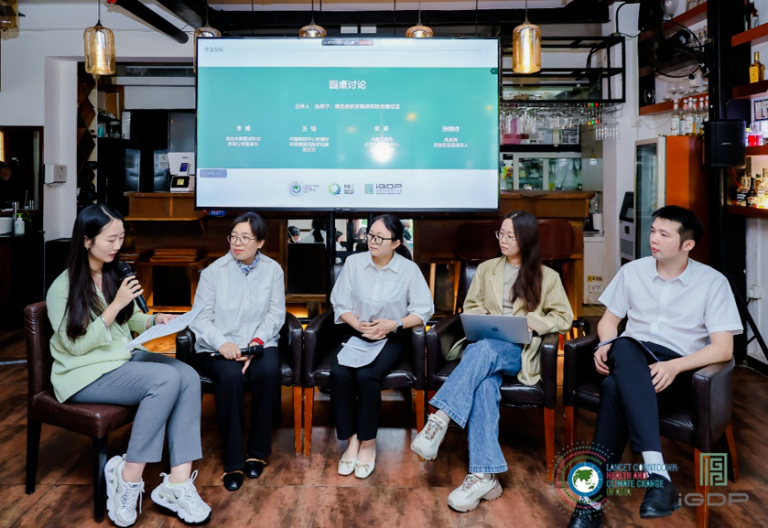
During the roundtable discussion, experts from enterprises, industry associations, and certification bodies held in-depth exchanges on the development of methodologies for methane emission reduction in the waste sector, the establishment of monitoring and accounting systems, and industry practices. The experts focused on the progress and challenges in developing voluntary emission reduction methodologies for food waste treatment and municipal solid waste landfills, and also discussed the methane emission reduction potential of wastewater and sludge treatment. The experts generally agreed that greater economic incentives should be introduced, interdepartmental coordination mechanisms should be improved, the development of localized emission factor databases should be accelerated, continuous monitoring capacity and data quality should be enhanced, and methane emission reduction in the waste sector should be further advanced.
iGDP has long focused on methane emission reduction in the waste sector. It has previously published reports including Guidelines on Good Practices for Municipal Solid Waste and Municipal Sludge Treatment in Chinese Cities and Status and Outlook of Non-CO₂ Greenhouse Gas Emission Reduction in China’s Waste Management Sector, focusing on key issues such as methane emission reduction in the waste sector and promoting cross-sectoral exchange and consensus-building. Going forward, we look forward to working with partners to explore more forward-looking and actionable pathways for low-carbon transformation.