

July 13, 2026
Madrid, Spain
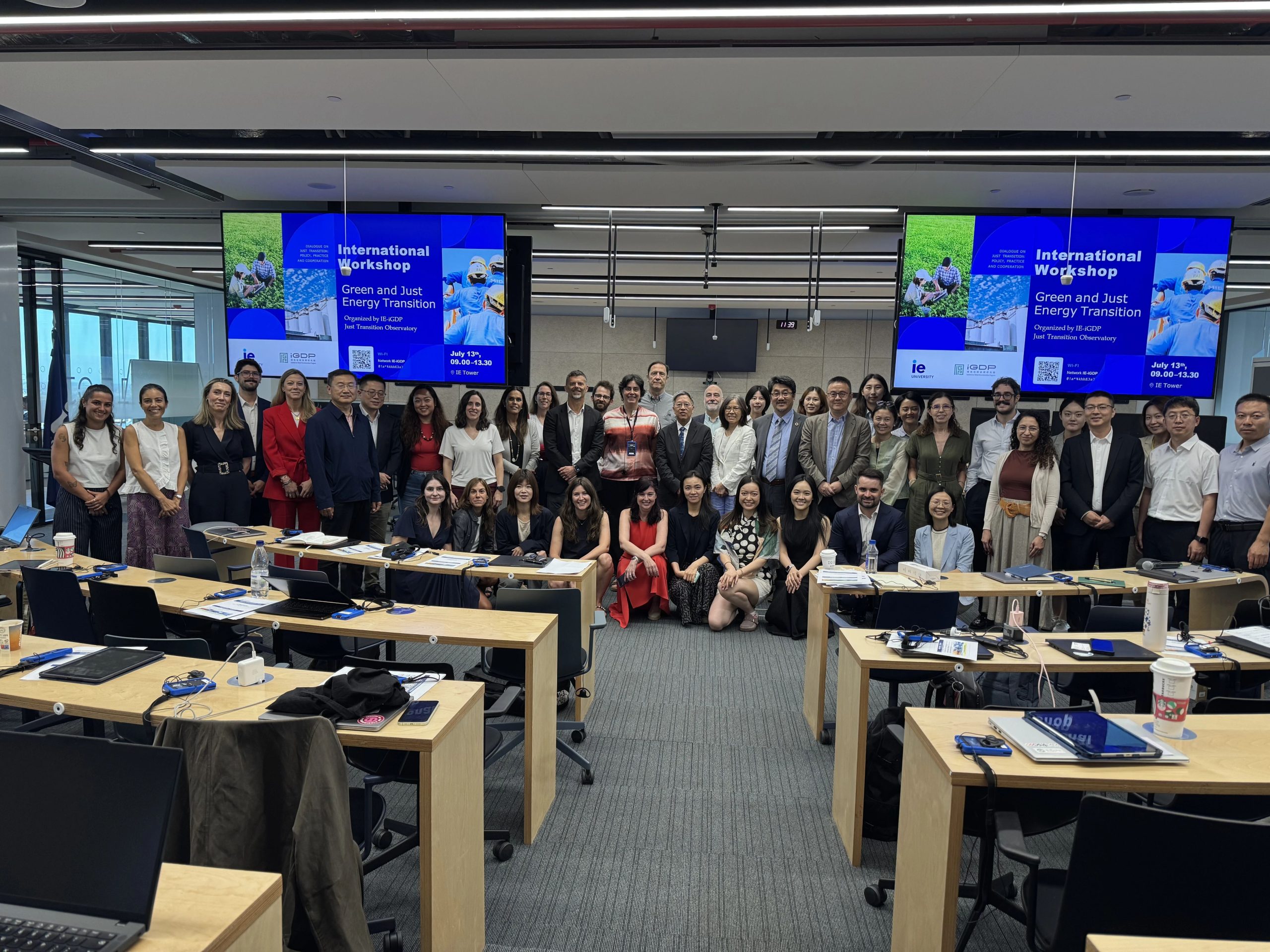
On July 13, 2026, the International Seminar on Green and Just Energy Transition was held at IE University in Madrid, Spain. The seminar was organized by the IE-iGDP Just Transition Observatory, jointly established by iGDP and IE University, under the theme “Just Transition: Policies, Practices and Cooperation.”
01 Global Consensus and Structural Differences Across Transition Stages
The seminar noted that as global climate governance shifts from target-setting negotiations to implementation, international discussions on just transition have increasingly focused on governance mechanisms, financing instruments, and capacity building for implementation. However, significant structural differences exist in the transition challenges faced by different regions.
For China, traditional energy-producing regions bear the dual responsibility of safeguarding energy security while facing multiple pressures related to industrial upgrading, employment transition, and local economic development. Experts noted that more than 2 million people are currently directly employed in coal-based industries across China’s Coal Triangle Region, and this number is projected to decline sharply to fewer than 300,000 by 2060. Although the new energy sector has created a large number of new jobs, substantial mismatches remain between newly created and displaced jobs in terms of both skill requirements and geographic distribution, posing a major challenge to a just transition.
Across the broader Asia-Pacific region, countries face not only the risk of carbon lock-in from coal-fired power assets but also a critical window for infrastructure development. Experts pointed out that approximately 75% of global coal-fired power capacity is concentrated in the Asia-Pacific region, and the region is expected to account for approximately 95% of newly added coal-fired power capacity worldwide over the next decade. Given that approximately 60% of the region’s infrastructure has yet to be built, the present moment represents a valuable opportunity to achieve a just transition “in one step.”
Unlike regions that remain heavily dependent on fossil fuels, Latin America already has a relatively low-carbon energy structure. Its just transition challenges stem more from structural adjustments in the agriculture, forestry, and transport sectors. Combined with debt burdens, low economic growth, and income distribution challenges, the region needs to pay particular attention to workers in the informal economy and explore social protection measures such as universal basic income to help alleviate the disruptions associated with the transition.
02 China’s Practice: Institutional Development and Sectoral Transitions
The seminar also featured discussions on China’s green and low-carbon transition practices. Participating experts introduced the latest progress in continuously improving China’s policy framework for achieving its carbon peaking and carbon neutrality goals and shared practical experiences from resource-based regions, industrial parks, and the transport sector.
First, experts highlighted the demands for a just transition in traditional energy bases. They proposed that the transition of resource-based regions should be advanced along three dimensions: industrial transition justice, through the orderly upgrading and phase-out of coal-based industries; ecological restoration justice, through strengthened ecological governance and restoration in mining areas; and employment and livelihood justice, through improved skills training and social security systems for miners. Enhancing the sustainable development capacity of resource-based regions requires stronger policy frameworks, greater cross-regional coordination, and improved industrial planning and guidance.
Second, the development of zero-carbon industrial parks is emerging as an important driver of industrial green transformation. National-level and provincial-level industrial parks in China host approximately 80% of the country’s industrial enterprises and account for approximately 31% of industrial carbon emissions. By increasing the share of clean energy consumption and the proportion of green electricity direct connection, zero-carbon industrial parks are becoming key platforms for industrial decarbonization and industrial restructuring.
Third, the transport sector will be a major focus of China’s next phase of emission reduction efforts. According to experts, Hainan was the first province to propose a roadmap for phasing out the sale of conventional fuel vehicles by 2030, and new energy vehicles already account for more than 60% of vehicle sales. However, hard-to-electrify sectors such as long-haul freight transport and shipping will still require green fuels, including green hydrogen, green ammonia, and green methanol, to advance their low-carbon transition.
03 Lessons from Europe: Corporate Exit Mechanisms and Urban Climate Governance
Europe has accumulated extensive practical experience in coal-fired power phase-out and industrial decarbonization. Its practices regarding corporate responsibility, local participation, and community well-being offer valuable insights. Participating experts shared relevant practices and representative case studies.
At the corporate level, experts presented Spain’s experience in the orderly phase-out of 5.9 GW of coal-fired power capacity. Three key lessons emerged from this case. First, just transition plans must precede plant closures. Companies, labor unions, and local governments signed diversification agreements several years before shutdowns took place. Second, project quality is more important than project quantity. During the transition of one power plant, 32 alternative industrial projects were publicly solicited, only two passed feasibility assessments, and ultimately only one entered implementation. Third, coal-fired power phase-out is a systemic undertaking encompassing workforce transition, capacity building, and local development. Through a combination of employee retraining, local employment, community skills training, and renewable energy project development, companies helped resource-based regions achieve a smooth transition.
At the urban level, the Madrid municipal government has advanced climate action through its “Madrid 360” strategy, emphasizing that a just urban transition should not only reduce greenhouse gas emissions but also integrate climate adaptation and social equity considerations. In response to risks such as extreme heat and water scarcity, the municipal government has focused on strengthening the adaptive capacity of vulnerable groups, including low-income communities. Through measures such as urban renaturalization, Madrid has improved local microclimates and partnered with the Technical University of Madrid to combine public education with community resilience building. In addition, through public-private partnership mechanisms, the city has encouraged corporate participation in urban greening and local carbon offsetting, promoting synergies among emission reduction, climate adaptation, and residents’ well-being.
04 Key Bottlenecks and Lessons from China–Europe Exchange
The seminar concluded that despite differences in development stages and energy structures across countries, several common challenges continue to hinder progress toward a just transition.
First, financing mechanisms remain a major bottleneck for a just transition. Research shows that in China’s Coal Triangle Region alone, financing needs for transition and upgrading in key coal-based industries are estimated at approximately USD 253.5 billion during the period from 2025 to 2030. Areas such as ecological restoration in mining regions and workforce resettlement possess strong public-good characteristics and are therefore less attractive to commercial capital. Public funding, dedicated funds, and innovative blended finance instruments will need to play complementary roles.
Second, employment challenges are increasingly characterized by skills mismatches. While green industries are creating new employment opportunities, helping workers from traditional industries successfully transition to new skill sets and expanding access to green jobs for women and young people remain important challenges shared across countries.
Third, local governments and communities should become important participants in the just transition process. Several experts noted that the commonly observed model in which “national governments formulate strategies while local actors are merely consulted” often prevents transition plans from being translated into tangible investments and industrial opportunities at the community level. Only through sustained stakeholder engagement, local industrial development, and long-term capacity building can broader social support be strengthened and a more solid foundation established for green transition.
05 IE-iGDP Just Transition Observatory: Latest Progress on the Just Transition Readiness Assessment Framework
Just transition has long been one of iGDP’s key areas of focus. In recent years, iGDP has continued to deepen its research and international cooperation in this field. In February 2025, iGDP joined hands with IE University and the IE Foundation to establish the IE-iGDP Just Transition Observatory.
During the seminar, representatives of the Lab introduced the Just Transition Readiness Assessment Framework currently under development. The framework aims to identify just transition risks and levels of preparedness across countries and regions through a unified set of assessment indicators and analytical tools. It consists of two core tools: the Just Transition Readiness Index, which focuses on cross-country comparison, and the Just Transition Readiness Matrix, which focuses on country-level policy analysis.
The assessment framework is built around six pillars—governance, labor, social equity and well-being, economy, climate, and environment—and evaluates both transition risks and adaptive capacity. By balancing international comparability with national applicability, the framework is intended to provide a reference for countries conducting just transition assessments.
Just transition is increasingly becoming a critical issue linking climate action, industrial development, and social equity. Discussions at the seminar covered transition practices in China, Spain, the Asia-Pacific region, and Latin America, presenting a multidimensional perspective on just transition challenges. A broad consensus emerged among participating experts: there is no single template for a just transition, but financing mechanisms, skills training, and governance frameworks constitute common challenges across countries and require continued international exchange and targeted policy design.
Looking ahead, iGDP will continue to leverage the IE-iGDP Just Transition Observatory to deepen research on just transition, strengthen international case studies and policy dialogue, and provide knowledge support and policy references for advancing green and just energy transitions in countries around the world.


