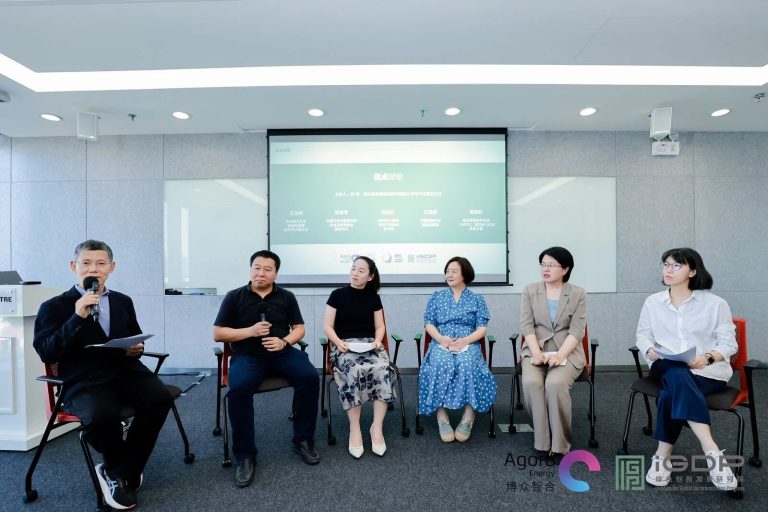
On January 24, the “Climate Catalyst × Tiangong Academic Salon — Green Fuels and Emission Reduction in China’s Transport Sector: Application Pathways and Industrial Development” was successfully held in Beijing. The salon was jointly organized by the Tsinghua Tiangong Think Tank and the Institute for Global Decarbonization Progress (iGDP), with support from the Smart Freight Center (SFC). It brought together experts and representatives from policy research, industry, and finance to discuss the application pathways and industrial development of green fuels in the transport sector. Participants focused on key issues including standards and certification systems for sustainable aviation fuel (SAF), green methanol, and green ammonia, pathways for reducing costs and improving efficiency, bottlenecks to large-scale deployment, and alignment with international rules.
The academic salon was moderated by Zhou Yufei, Senior Project Manager at the Smart Freight Center. Mo Zhengchun, Director of the Institute for Global Decarbonization Progress (iGDP), delivered opening remarks, noting that global climate change is at a critical “crossroads” and that green fuels are key to emissions reduction in sectors that are difficult to electrify. He emphasized that China has significant advantages in green technology development and manufacturing, and that the development of green fuels is on the verge of rapid growth. He also expressed hope that Chinese standards and rules would advance in step with international standards and rules.
During the guest presentations, Wu Bixuan, Deputy Director of the Tiangong Think Tank Center at the Tsinghua Suzhou Environmental Innovation Institute, delivered a presentation titled “Sustainable Fuel Rules: Semantic Misalignment.” He analyzed the semantic misalignment surrounding the concept of “sustainable fuels,” provided a detailed interpretation of the dual-standard logic of sustainability and greenhouse gas emissions savings under relevant regulations, and emphasized the fundamental role of regulatory standards within the sustainability ecosystem, cautioning enterprises against misunderstandings of certification mechanisms.
A representative from the Energy Research Institute of the National Development and Reform Commission shared insights on “Pathways for Reducing the Costs of Green Fuels.” By analyzing the current production capacity and cost structures of green hydrogen, green ammonia, and green methanol, the representative pointed out that the key to reducing overall electricity costs lies in “weak grid connection” and “local consumption.” The representative also emphasized that the industry needs to focus on “effective demand at affordable prices” and that future technology pathways should be developed based on China’s own circumstances, while accelerating cross-sectoral integration between energy and power systems and chemical systems.
During the roundtable discussion, themed “Green Fuel Development and Emission Reduction in China’s Transport Sector,” the salon was moderated by Yuan Yating, Analyst at the Institute for Global Decarbonization Progress (iGDP). Participants included Bi Qinghua, Deputy Director of the Green Transport Division of the Development Center of the China Academy of Transportation Sciences; Lü Wei, Chairman of Beijing Zhonghuan Zhiyun Eco-Environmental Technology Co., Ltd.; Zha Hao, Head of the Energy Sector at Huayuan Securities Research Institute; Zhao Yue, Deputy Editor-in-Chief of China Petroleum and Petrochemical; and You Mengxue, Carbon and Energy Transition Market Analyst at Argus Media.
From diverse perspectives including policy direction, production technologies, finance and capital, infrastructure development, and international market prices, the participants discussed the positioning of green fuels during the 15th Five-Year Plan period, analyzed the impact of the green premium on market demand, and exchanged views on practical challenges such as establishing domestic standards and addressing international carbon barriers.
At the conclusion of the salon, Wu Bixuan, Deputy Director of the Tsinghua Tiangong Think Tank, delivered closing remarks. He emphasized that regardless of fluctuations in international policies, “sustainability” and “lifecycle-wide carbon emissions reduction” will remain the core value logic of green fuels.
Through exchanges across policy, technology, and markets, the salon not only clarified the practical challenges facing green fuel development, but also provided important insights into how China’s transport sector can chart its own pathway amid global efforts to reduce emissions.