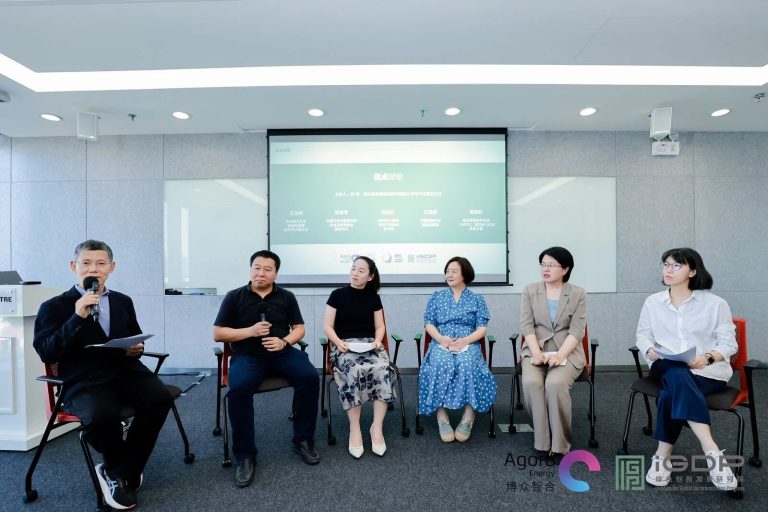
On April 22, 2026, Climate Catalyst: From “Old Houses” to “Good Homes” — Seminar on Low-Carbon Renovation of Existing Buildings was successfully held. The seminar was jointly organized by the Institute for Global Decarbonization Progress (iGDP) and Shenzhen Institute of Building Research Co., Ltd., with support from the Ecological Community Professional Committee of the Chinese Society for Environmental Sciences and the Ecological Committee Academic Salon of the Chinese Society for Urban Studies. The seminar brought together industry experts and corporate representatives for in-depth discussions on policy standards, financial innovation, technology integration, and engineering practices, providing practical insights for improving the quality of existing buildings and promoting green and low-carbon transformation. Li Fen, Deputy Chief Engineer of Shenzhen Institute of Building Research Co., Ltd., moderated the seminar. Fu Yu, Deputy Secretary-General of the China Association of Building Energy Efficiency; Wu Kexin, Deputy Manager of the Technology and Design Management Department of CSCEC Fangcheng Technology; Xu Li, Chief Engineer of Green Building at China Urban Construction Design & Research Institute; and Ren Jun, Deputy Director of the Energy Institute of China IPPR International Engineering Co., Ltd., delivered thematic presentations.
Fu Yu, Deputy Secretary-General of the China Association of Building Energy Efficiency, provided a systematic interpretation of the policy and standards framework for low-carbon renovation of existing buildings. She noted that carbon emissions from the building sector account for 22.1% of China’s total energy consumption, while the area of non-energy-efficient buildings in urban areas requiring renovation has reached 16.4 billion square meters, indicating significant renovation potential. China has established a four-dimensional policy framework driven by targets, regulations, economic instruments, and markets, while local governments are shifting from broad-based subsidies toward performance-based subsidies. She emphasized that the major bottlenecks at present are fragmented property ownership and fragmented returns. She recommended incorporating renovation requirements more deeply into urban renewal regulations, establishing a building carbon allowance system, accelerating coordination between carbon emission databases and standards, and promoting a transition from renovation as an encouraged option to a comprehensive requirement for buildings meeting renovation criteria.
Wu Kexin, Deputy Manager of the Technology and Design Management Department of CSCEC Fangcheng Technology, shared pathways for coordinated innovation in green and low-carbon renovation of residential communities and green finance based on corporate practices. As an urbanization investment platform under China State Construction Engineering Corporation (CSCEC), CSCEC Fangcheng promotes urban renewal through an integrated full-chain approach, achieving the application of low-carbon technologies and green certification in projects including the renovation of old residential communities and the Xinhua Bookstore. He proposed matching renovation projects with diversified green financial instruments and capitalizing green assets through innovative financing instruments such as green bonds and sustainability-linked bonds, thereby addressing the challenges of high investment, long payback periods, and slow returns, and generating diversified returns from energy savings, carbon benefits, and environmental value.
Xu Li, Chief Engineer of Green Building at China Urban Construction Design & Research Institute, focused on the integrated application of energy efficiency and carbon reduction technologies for existing buildings. She proposed a problem-oriented approach to existing-building renovation based on the core pathway of “passive energy efficiency + active efficiency + renewable energy utilization,” achieving carbon reduction through three dimensions: the building itself, energy systems, and smart operations and maintenance. Drawing on cases including the terminal building of Hefei Garden Expo Park and the renovation of the Inner Mongolia Architecture Museum, she demonstrated the application of technologies such as light-gauge steel structures, natural lighting and ventilation, and green building materials. She noted that current challenges include technology adaptability, coordination among standards, and missing operations and maintenance data. Future development will focus on greater technology integration, lower-carbon energy use, and smarter operations and maintenance.
Ren Jun, Deputy Director of the Energy Institute of China IPPR International Engineering Co., Ltd., analyzed approaches to low-carbon heat-source design for residential building renovation from the perspective of heating. He introduced the application characteristics of low-carbon energy sources including shallow geothermal energy, medium- and deep-geothermal energy, and sewage-source energy. He noted that low-carbon energy sources are generally characterized by low temperatures and small temperature differentials, resulting in limited compatibility with traditional district heating systems. The selection of a technical pathway should therefore take into account multiple factors, including energy parameters, resource endowments, and economic feasibility. Renovation principles can be tailored to different climate zones: in severe cold and cold regions, the focus should be on low-carbon renovation of district heating systems; in regions with hot summers and cold winters, the focus should be on community-level distributed low-carbon energy; and in regions with hot summers and warm winters, the focus should be on upgrading high-efficiency cooling equipment. Meanwhile, heating design water temperatures should be reduced, source-side configurations should be selected appropriately, and source-to-end matching should be improved.
During the roundtable discussion, the thematic speakers and Peng Rui, Senior Urban Planning Engineer at Shenzhen Institute of Building Research Co., Ltd., held in-depth discussions on key issues including institutional barriers, technology deployment, financing models, resident participation, and integration with urban renewal. The participants reached a clear consensus: low-carbon renovation of existing buildings is a systematic undertaking involving policies, technologies, financing, markets, and residents. At present, renovation of residential buildings is particularly challenging because of fragmented property ownership and high coordination costs. The Shanghai model of centralized management could be referenced to clarify responsible entities. Technology deployment requires stronger closed-loop supervision covering the entire process from design and construction to acceptance, together with greater efforts to encourage low-carbon behavior among users. Financing should follow a “one project, one policy” approach and combine multiple channels, including dedicated government subsidies, green finance, and market-based returns. Low-carbon renovation should be fully integrated into the core stages of urban renewal project approval, planning, and funding arrangements, with carbon assessments and performance evaluations incorporated into the process, so that green and low-carbon development shifts from an “optional” to a “mandatory” requirement. These efforts can jointly promote the transformation of old houses into safe, livable, low-carbon, and high-quality “good homes.”
The seminar built consensus across the industry and provided feasible policy, technological, financial, and practical pathways for transforming existing “old houses” into livable, low-carbon, high-quality “good homes,” contributing to the achievement of the “dual carbon” goals in the building sector and high-quality urban development.