
Food Cold Chain Non-CO₂ GHG Emission Reductions in China
Challenges and Opportunities
English
NOV 2022
Policy Brief
Beyond Carbon Climate-Food GAAP
Summary:
This policy brief examines non CO₂ GHG emissions from China's rapidly developing food cold chain industry, including both refrigerant leakage (F gases with high global warming potential) and indirect emissions from energy consumption. It finds that while expanding cold chain coverage can significantly reduce food loss related methane emissions, it also introduces new emission sources. Through scenario analysis, the brief shows that adopting low GWP refrigerants, improving energy efficiency, and transitioning to renewable energy and electric vehicles can substantially reduce emissions. It recommends establishing a national framework aligned with the Kigali Amendment, improving data collection and monitoring, accelerating refrigerant replacement, and enhancing technician training and equipment maintenance to support a low carbon cold chain transition.
Suggested citation:
Hong, J., Yang, L., Hu, M., & Mo, K. (2022). Food Cold Chain Non-CO₂ GHG Emission Reductions in China. Policy Brief. Beijing: Institute for Global Decarbonization Progress (iGDP).
Related
-
Q&A: What is in China’s new five-year plan for climate change?China has released a five-year plan dedicated to addressing climate change.Interview AUG 2026
-
China Signals Nation Is Ready to Lead Global Climate ActionInterview JUL 2026

-
A Reduction Capacity of 30 Million Tonnes of CO₂ Equivalent to Be Developed: Non-CO₂ Greenhouse Gas Control Accelerates Nationwide | Decoding Climate Plans①Recently, the Ministry of Ecology and Environment, in collaboration with the National Development and Reform Commission and 18 other departments, jointly issued the “National 15th Five-Year Plan for Climate Change Response,” establishing for the first time a comprehensive, all-encompassing system of climate change response targets at the five-year planning level.Interview JUL 2026

-
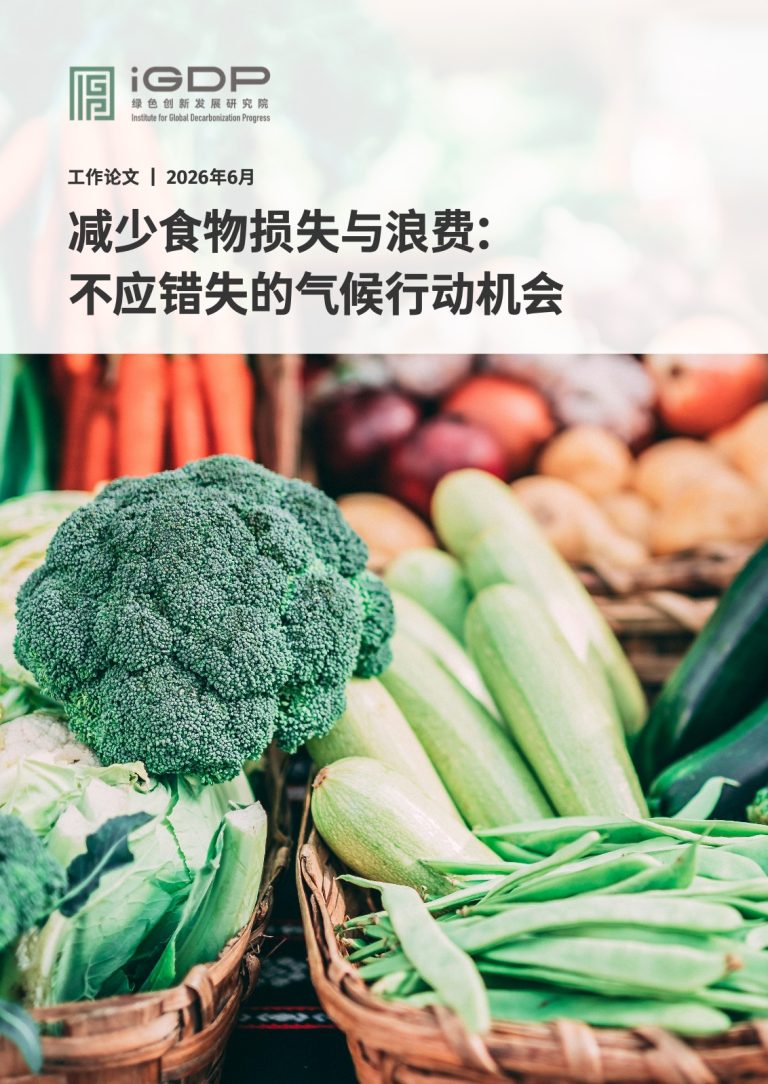
Reducing Food Loss and WasteThis working paper quantitatively examines the scale and climate impact of food loss and waste (FLW) in China. It analyzes the uneven distribution of FLW across supply chain stages and food types, highlighting that while vegetables account for the largest share of losses, livestock products carry disproportionately high emissions intensity. The paper reviews China's evolving policy landscape, including the Anti-Food Waste Law and cold chain development initiatives, while identifying critical gaps in data infrastructure, sustainable cold chain coverage, and consumer behavior interventions. It explores the dual role of cold chain logistics—reducing post-harvest losses while contributing significant energy-related and refrigerant emissions—and assesses the potential of business innovations, public engagement, and food waste valorization to mitigate FLW. The paper calls for integrating FLW reduction into climate governance frameworks, proposing four priority pathways: establishing systematic FLW data systems, advancing sustainable cold chain solutions, strengthening circular utilization of food waste, and promoting green consumption patterns to unlock a cost-effective, high-potential climate mitigation opportunity.Working Paper JUN 2026
-
The “Hidden Carbon Footprint” Behind Our Plates: Food Supply Chain Emission Reduction Is ImperativeAt the meeting, expert representatives from sectors such as cold-chain logistics, carbon management, and the food industry discussed the key challenges in reducing emissions along the supply chain and explored pathways for transformation that deliver both environmental benefits and economic value.Interview DEC 2025
-
Agri-Food Super Pollutants Reduction in ChinaThis policy brief analyzes reduction opportunities for "super pollutants" (methane, nitrous oxide, hydrofluorocarbons, black carbon, and ground-level ozone) from China's agri-food system. It focuses on three key areas: nitrogen fertilizer use and nitrous oxide emissions, food loss and waste and associated methane emissions, and rural energy use and black carbon emissions from cooking and agricultural machinery. It synthesizes scientific literature, official statistics, and policy documents to quantify emissions, identify mitigation potential, and catalog the climate, health, economic, and social co-benefits of action. It finds that super pollutant mitigation offers "triple-win" outcomes—climate, health, and socioeconomic—and identifies three emerging opportunities: supportive national and provincial policies, expanding green finance and carbon market mechanisms, and the growing role of new agricultural business entities in driving technology adoption at scale.Policy Brief NOV 2025