
January 8, 2026
Beijing
The seminar was jointly organized by iGDP, the Center for Climate Communication and Risk Governance at the School of Journalism and Communication, Tsinghua University, and Zero Carbon Era. Experts with long-term engagement in climate communication research and firsthand experience at COP30 analyzed, from multiple perspectives, the contributions and impacts of diverse climate actions in fulfilling climate commitments.

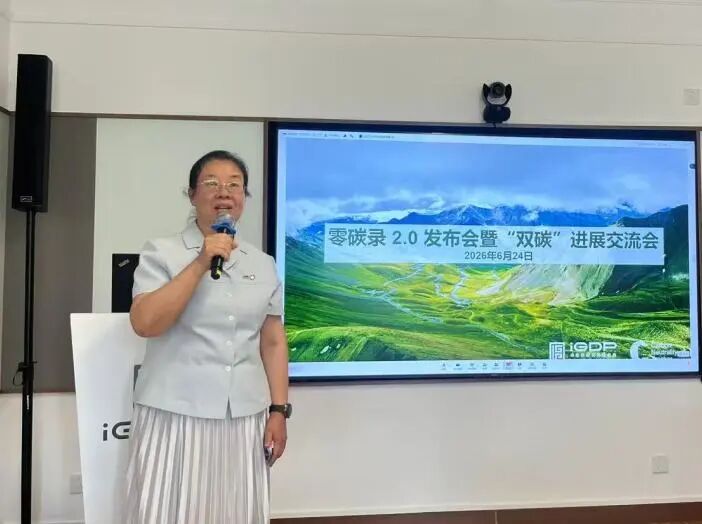
On January 8, 2026, the Climate Catalyst: After COP30, How Will the Climate Narrative Develop in the New Year? seminar, jointly organized by iGDP, the Center for Climate Communication and Risk Governance at the School of Journalism and Communication, Tsinghua University, and Zero Carbon Era, was successfully held as scheduled. Wang Mou, Researcher at the Institute of Ecological Civilization Studies, Chinese Academy of Social Sciences; Han Shulin, Executive Editor-in-Chief of Zero Carbon Era; Zhang Shihui, Assistant Professor at the School of Ecology and Environment, Renmin University of China and Research Director of the Lancet Countdown Asia Centre; and other experts with long-term engagement in climate communication and firsthand experience at COP30 analyzed from different perspectives the contributions and impacts of diverse climate actions on fulfilling climate commitments.
More than 40 partners in the field of climate communication engaged in group discussions and exchanged their expectations and ideas for COP31. The seminar was moderated by Lü Yaning, Communications Manager at iGDP, and concluded by Zeng Fanxu, Director of the Center for Climate Communication and Risk Governance at the School of Journalism and Communication, Tsinghua University.
01 Analysis of the Key Outcomes of COP30 and the Focus of Subsequent Negotiations
Wang Mou reviewed the outcomes of COP30 and analyzed the key issues for subsequent negotiations. As a scholar who has long been involved in the global climate governance process, he shared the following key observations:
COP30 upheld the core positions of developing countries: the outcome documents reaffirmed the three core principles of “common but differentiated responsibilities,” the financial obligations of developed countries, and historical responsibility;
After difficult negotiations, 59 indicators under the Global Goal on Adaptation (GGA) framework were adopted. As a “non-mandatory and non-intrusive” set of indicators, there remains considerable room for discussion on their future implementation, but the framework provides a basis for future adaptation action;
Article 9.1 of the Paris Agreement, concerning financial support from developed countries to developing countries, was incorporated into a two-year work program. For the first time, trade and unilateral measures were included in a document under the Paris Agreement, and a three-year dialogue process was established. In addition, the conference established a goal of tripling adaptation finance by 2035, although the specific baseline and implementation pathways remain subject to further negotiations.
The Technology Implementation Programme (TIP) was launched to support the implementation of priorities identified by developing countries.
The Just Transition Work Programme was authorized to move forward. The issue of just transition is broadly linked to Nationally Determined Contributions (NDCs), the Global Stocktake and other processes. Trade-related unilateral measures, such as the Carbon Border Adjustment Mechanism (CBAM), have continued to receive attention under the just transition agenda, with developing countries calling for them to be incorporated into the negotiation process.
Wang Mou noted that COP30 made progress on multiple issues, but also left many challenges unresolved. Future negotiations will need to achieve substantive breakthroughs in areas including the allocation of responsibilities, delivery of climate finance and the refinement of concrete actions. Turning NDCs from commitments into implementation will remain a long-term challenge for the international community.
02 Climate Change Reporting from an Industrial Perspective
Drawing on his distinctive experience across the energy and climate sectors, Han Shulin explored the profound transformation from conflict to convergence between industrial logic and climate goals.
Han Shulin began his reporting career in the traditional energy sector. In 2015, he observed tensions emerging among climate goals, industrial logic and market logic, with the “energy trilemma”—affordability, low carbon and reliability—proving difficult to reconcile. The launch of China’s “dual carbon” goals in 2020 marked a key turning point. His coverage of green transition cases also shifted from focusing primarily on international transitions to covering the practices of Chinese companies, and eventually to his current work at Zero Carbon Era, a platform focused on green transition and development.
Han Shulin now pays greater attention to commercially viable technologies as drivers of the green transition. He shared two typical cases: more than 15 GW of distributed solar PV capacity in Pakistan installed voluntarily by ordinary residents, and the use of solar PV and energy storage in African countries to provide rural populations with access to clean electricity. These cases demonstrate that the substantial decline in the costs of green technologies such as solar PV and energy storage is making it possible for developing countries to bypass the traditional fossil-fuel stage and achieve initial modernization directly through renewable energy.
This commercially sustainable transition driven by industrial progress is emerging as a new form of “green soft power.” Although political dynamics in international climate negotiations remain important, China’s experience in driving down the costs of green technologies and exploring pathways toward modernization based on non-fossil energy provides valuable reference for the world, particularly for countries in the Global South.
03 Climate Is No Longer Just an Issue for Experts: Translating Science and Expanding Climate Action after COP30
Zhang Shihui noted that global climate governance is undergoing a fundamental transformation, with its defining feature being “breaking out of the circle”—from closed professional negotiations to open and diverse social action.
Based on her observations of COP30, she identified three major trends:
First, a quantitative expansion in participation: total participation at the conference rose to hundreds of thousands, with public activity areas outside the formal venue becoming a major source of growth;
Second, a qualitative diversification of participants: people from all walks of life, including entrepreneurs, artists and healthcare professionals, are becoming actively involved. For example, doctors are not only concerned about the health impacts of pollution but are also examining the carbon footprint of healthcare systems themselves;
Third, an expansion of the space for action: the focus of climate governance is shifting from negotiation texts toward industrial solutions, while the increasingly lengthy negotiation texts themselves reflect both the difficult process of building consensus among 198 Parties and the necessity of advancing concrete implementation.
As Research Director of the Lancet Countdown Asia Centre, Zhang Shihui shared key practices in translating scientific research into action:
First, making research more targeted by refining analyses of the health risks of climate change to 375 cities across China. She found that provincial-level data can obscure differences in risks among cities, providing a basis for more targeted local adaptation;
Second, quantifying the “economic costs and benefits.” For example, a meteorological early warning system for stroke in Tianjin saved RMB 28 million in medical expenditure with an investment of RMB 4 million and was included in the World Health Organization’s COP30 case database;
Third, improving public understanding by translating scientific indicators into tangible impacts, such as reductions in outdoor exercise time per capita and declines in labor productivity, making climate risks more tangible and understandable.
She emphasized that future climate action should not focus solely on costs or threats, but should also seize the opportunities for industrial upgrading that climate change presents. New growth areas can be created in energy transition, resilient infrastructure and climate-related health, among others. This requires deep engagement by diverse actors, including businesses, to turn climate action into a driver of economic growth and lead the way toward sustainable development.
04 Group Discussions: Communicating the COP31 Story
Participants at the seminar were divided into six groups. Each group discussed solutions from a communication perspective based on the issues that COP31 should genuinely address, followed by on-site exchanges and presentations.
Group 1
The first group believed that COP31 should be a COP focused on accelerating implementation, solidarity and multilateralism. They hoped to accelerate action and the implementation of the conference outcomes, while directly addressing the issue of climate finance and determining how a new climate governance mechanism should be established following the US withdrawal. They proposed organizing an environment- and climate-themed concert to encourage deeper participation from people beyond the climate community and the general public. They planned to use in-depth articles, impactful videos or on-site interviews at COP to showcase how developing countries, emerging industries and traditional energy cities could turn their situations around or gain a competitive advantage through future strategic planning. Although certain developed countries may create uncertainty for global climate governance, those that take the lead in overcoming challenges will be able to reshape the order and gain an advantage amid the broader trend of climate action.
Group 2
The second group described COP31 as a COP for just transition and argued that it must address three core issues: climate finance, sea-level rise affecting small island states, and just transition. Their proposed creative activity was an immersive exhibition featuring “bleached coral” from the Great Barrier Reef, using visual impact to help more members of the public and stakeholders experience the urgency of the climate crisis. Under the theme “Those Who Are Disappearing,” they planned to follow and document climate migrants who were forced to move from Tuvalu to Australia due to rising sea levels. Through documentaries, data-based investigations and photo stories, they would portray changes in their lives and the challenges surrounding their identities. They hoped to move audiences through real stories and call on the international community to accelerate the delivery of climate finance.
Group 3
The third group proposed that COP31 should become a “COP in Our Everyday Lives” or a “People’s COP,” emphasizing that climate action must rely on people. They identified three major challenges for the conference: the governance mechanism following the US withdrawal, the implementation of climate commitments by countries, and the need for all solutions to be grounded in localized and pragmatic practices.
To encourage public participation, the group planned to organize a creative activity or create an artwork under the theme “There Is Not Enough Time.” Through short videos and modern communication approaches, they would interview successful local businesses and communities to showcase successful localized practices and encourage other sectors to make changes. The group emphasized that COP31 would lose its meaning if it failed to deliver tangible results. The goal should be to give a broader range of people hope for the future of climate governance, while recognizing that the future also depends on the actions of every individual today.
Group 4
The fourth group placed “implementation” at the center and proposed three core issues for COP31: first, the financing gap; second, concrete pathways for just transition; and third, improving early warning systems to enhance the adaptive capacity of vulnerable regions.
The group advocated cross-sectoral cooperation and innovative forms of communication. It planned to promote interactive formats such as a “Cross-Sectoral Climate Action Forum” and a “Climate Action Market” at COP31, using performance art, cross-sectoral dialogues and film festivals to build bridges among decision-makers, young people and civil society organizations.
Group 5
The fifth group also identified “implementation” as the core theme of COP31, proposing a focus on climate finance and rising temperatures, while specifically calling for the United States to resume contributing to global climate action. To this end, the group proposed a targeted narrative strategy: using online dialogue to bridge differences in positions.
They planned to invite two US influencers with opposing views on climate issues to engage in a public dialogue or debate. By presenting a direct clash of different perspectives, they hoped to attract broader public attention, particularly among groups that are skeptical of or indifferent to climate change. The group believed that completely “changing” other people’s positions would be extremely difficult, and therefore adjusted its objective toward “influencing” and “attracting attention.” Low-cost online debates could facilitate exchanges among different viewpoints, raise public awareness and engagement on climate issues, and thereby help advance US climate action in a complex international political environment.
Group 6
The sixth group likewise emphasized that “implementation” should be a core issue for COP31, arguing that turning commitments into action is more important than setting new targets. They identified climate finance, pathways for the transition away from fossil fuels, and just transition as three key topics, with the future direction of the fossil-fuel transition as the primary focus.
The group particularly emphasized the power of “cross-sectoral” communication and proposed inviting industry leaders to participate in dialogues or debates, leveraging their influence to attract public attention. The communication focus should shift from amplifying climate anxiety toward promoting concrete and feasible technological solutions. The group hoped to use the COP31 platform to bring mature technologies to the public and make carbon reduction a tangible, perceptible and participatory part of everyday life. The central narrative would be “Time is running out, but solutions are already in hand,” conveying both urgency and hope for action. At the same time, the group emphasized that climate communication is difficult and often slow to produce results, and called on practitioners to adjust their expectations and mindset.
05 Seminar Summary
In his concluding remarks, Professor Zeng Fanxu noted that the themes and discussions of the day demonstrated an important shift from “science communication” toward “climate narratives.” Only by building emotional connections with the public through storytelling can climate communication truly “break out of the circle.”
He summarized the changes in the narrative approaches presented by the three keynote speakers. From the perspective of global governance, Wang Mou demonstrated a shift from grand goals toward implementation strategies and from moral narratives toward strategic narratives, focusing on the tensions and contestation involved in implementation. From an industrial perspective, Han Shulin explored how the once-disconnected “industrial narrative” and “climate narrative” can be bridged through business innovation, demonstrating the potential for synergy between the two. From the perspective of public participation, Zhang Shihui promoted a shift from policy elites toward diverse actors and “translated” scientific language into localized narratives connected to cities and individuals, thereby giving climate action a sense of hope.
Professor Zeng further noted that this shift echoes the exploration of “hope-oriented” narratives that emerged in the group discussions. He shared findings from the Center for Climate Communication and Risk Governance at Tsinghua University showing that young people tend to favor narratives centered on benefits and hope rather than appeals based on sacrifice. Going forward, it will be necessary to continue exploring narrative approaches that are rooted in Chinese society and culture and are more innovative and engaging.