

June 24, 2026
Beijing
At the event, iGDP launched China Carbon Neutrality Tracker (CCNT) 2.0, and invited guests from research institutions and media organizations to discuss how databases can better support policy research and climate communication, with a focus on new trends in China’s “dual carbon” development during the 15th Five-Year Plan period.
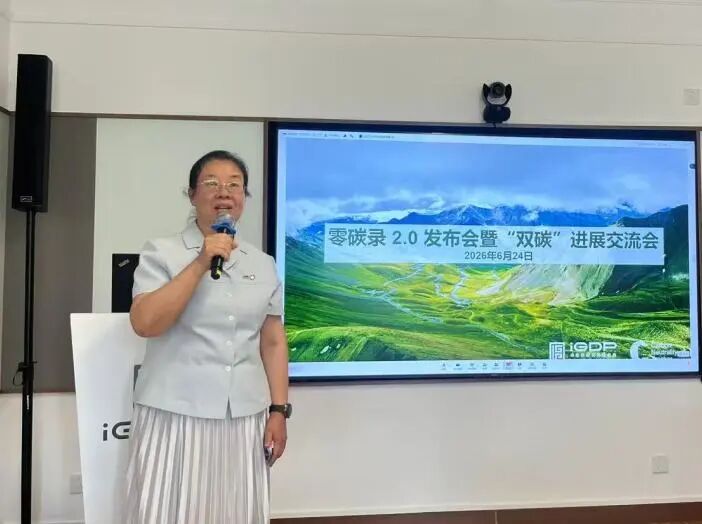
The first half of the seminar was moderated by Zhu Tongxin, Analyst at iGDP. She introduced the China Carbon Neutrality Tracker (CCNT), an online carbon neutrality information database established and maintained by iGDP, which aims to communicate and share China’s efforts and contributions to addressing climate change from an objective and scientific perspective. As China’s “dual carbon” policy framework continues to improve and its green and low-carbon transition advances, CCNT has also been continuously upgraded and improved.
Chen Ying, Researcher at the Institute of Ecological Civilization Studies and Director of the Center for Sustainable Development Studies at the Chinese Academy of Social Sciences, delivered the opening remarks. As Chair of the Expert Group of the CCNT Expert Committee, she shared her observations on the development of CCNT and her experience using the database.
Li Siyin, Assistant Analyst at iGDP, then introduced the updates and upgrades to CCNT 2.0. She noted that CCNT 2.0 currently has three main types of products:
First, the Zero-Carbon Action Database, which mainly collects national-, provincial-, and city-level climate change policies issued since the 12th Five-Year Plan period. By extracting the key content of these policies, the database enables readers to quickly access and understand policy information. The database supports searches by sector, region, and key issues. To date, the Action Database has collected more than 670 national-level policies, more than 1,700 provincial-level policies, and nearly 900 city-level policies.
Second, the Provincial “Dual Carbon” Action Tracking Pages, which use visualized charts to present the progress of the “dual carbon” transition across China’s 30 provincial-level administrative regions. The pages present historical trends in provincial green and low-carbon transition from multiple dimensions, including energy-related CO₂ emissions, sectoral emissions structure, energy consumption structure, and the decoupling of economic growth from carbon emissions. By comparing each province with the national average and applying the Low-Carbon Transition Progress Assessment Framework for China’s Regions (LOGIC) developed by iGDP, the pages identify areas of advanced progress and areas requiring improvement in each province’s “dual carbon” development. Based on historical trends, the provincial pages incorporate “dual carbon” development targets for key sectors, including energy, electricity, transport, buildings, and agriculture, as set out in relevant policies, and use the Energy Policy Simulator (EPS) developed by iGDP to forecast future carbon emission trends in each province. The pages also provide an overview of each province’s “dual carbon” policies. By tracking transition progress across multiple dimensions, the provincial pages enable users to quickly and comprehensively understand the “dual carbon” development of China’s provinces.
Third, information products, which are intended to provide more timely updates on the latest “dual carbon” actions at the national and local levels. These mainly include the CCNT Weekly, CCNT Bimonthly, CCNT Annual Report, and Issue Tracking Briefs. The English-language bimonthly report summarizes key national and local “dual carbon” actions and provides an in-depth analysis of one major national policy or hot topic in each issue, with the aim of helping English-speaking readers better understand China’s progress toward its “dual carbon” goals. The iGDP research team also publishes policy briefs, commentaries, and other materials on an ad hoc basis, covering topics such as NDC implementation, local progress toward the “dual carbon” goals, low-carbon transition in sectors including transport and buildings, and cross-cutting hot topics such as non-CO₂ greenhouse gas emission reductions and zero-carbon parks.
The CCNT 2.0 upgrade mainly includes methodological updates, data updates and expanded indicators on the provincial pages, and improvements to the search function. In terms of methodological updates, policies are classified into 12 major areas and 26 topics, with emerging hot topics such as zero-carbon parks and coordinated pollution and carbon reduction incorporated into the classification system. For the provincial pages, new LOGIC-based low-carbon progress assessments and carbon emission forecasts have been added, while the page data have been comprehensively updated. At the same time, the fuzzy search function enables users to conduct more comprehensive searches on topics of interest. The key highlights of the CCNT upgrade can also be found in: “CCNT 2.0 Is Now Live! A First Look at Three Major Upgrades.”
During the thematic presentations, several experts shared their observations on progress in the “dual carbon” field:
Chen Ying, Director of the Center for Sustainable Development Studies at the Chinese Academy of Social Sciences, analyzed the new landscape of global climate governance. Based on global and domestic climate change trends and the increasing frequency of extreme weather and climate events, she pointed out that the challenges of climate adaptation are becoming increasingly severe. At the same time, the 1.5°C threshold is drawing closer, while the world continues to face a dual deficit in climate targets and action. The intensification of regional conflicts and major-power competition, the increasing judicialization of climate governance, the intersection of international trade and climate governance, and the growing prominence of geopolitical issues surrounding critical minerals have created uncertainty for the green and low-carbon transition. At the same time, however, the global energy transition remains an unstoppable trend, and China’s investment and achievements in clean energy have attracted worldwide attention. In terms of domestic development, electricity demand from AI computing continues to rise, making the development of AI with green electricity and the coordinated development of computing power and electricity an inevitable choice. AI technology itself is also regarded as a tool for facilitating the transition and is expected to enable China’s computing power to support the global green and low-carbon transition. Looking ahead to the 15th Five-Year Plan period, China’s green and low-carbon development is entering a new stage of rule-of-law-based governance. China has clear targets and strong measures for achieving carbon peaking on schedule, but it is also necessary to recognize the new internal and external challenges facing renewable energy development and integration.
Ding Shanshan, Director of the Green Supply Chain Program at the Institute of Public & Environmental Affairs (IPE), pointed out that steel and aluminum, as major sources of industrial carbon emissions in China, have made significant progress in areas such as energy efficiency improvement, process optimization, and the utilization of recycled resources. However, challenges remain, including inconsistent standards for certifying low-carbon products, difficulties in carbon accounting, and inadequate circular economy systems. The downstream automotive industry is an important consumer of steel and aluminum, but has shown limited willingness to bear the “green premium.” In response, IPE uses product carbon footprint data publicly released through platforms such as the China Auto Supply Chain Carbon Disclosure Platform (CPP) and the Chinese Product Carbon Footprint Database (CPCD), together with product carbon footprint data disclosed by automakers themselves, to guide consumers to pay attention to, express, and amplify their preferences for low-carbon vehicle models. This approach seeks to drive transformation in the automotive industry from the consumption side and subsequently transmit demand for low-carbon products upstream to steel and aluminum producers. Ding Shanshan also introduced Carbon Easy Check, a tool jointly developed by IPE and CPCD. The public can use AI-based image recognition to query the carbon footprints of products and activities related to clothing, food, housing, and transport. As an important component of the “Environmental Protection at Your Fingertips” public-interest initiative, IPE hopes to lower barriers to public participation, encourage people to start with small actions in their everyday lives, practice a low-carbon lifestyle, and become active contributors to the development of a Beautiful China.
Sun Yixian, Professor of Sustainable Governance at the University of Bath, shared his views on China’s role and influence in global climate governance and the energy transition. As China’s domestic environmental policies have developed and improved, China has become increasingly proactive in participating in the institutional design of global environmental governance. In the energy transition, China has continued to strengthen overseas investment and financing in renewable energy while leveraging its advantages in clean energy technologies and cost competitiveness to improve energy access and promote the transition toward cleaner energy, including in countries of the Global South. Drawing on the China Global Environmental Leadership (CGEL) Database developed by his team, Professor Sun pointed out that the actors involved in China’s environmental initiatives have become increasingly diverse over the past decade, encompassing not only government agencies but also research institutions, enterprises, and other stakeholders. Compared with the model adopted by developed countries, which focuses more on directly providing funding, China has placed greater emphasis on information sharing and capacity building.
During the seminar, Zhu Tongxin, Analyst at iGDP, shared the contents of the CCNT Annual Report, Ten-Year Assessment of Green and Low-Carbon Transition Progress Across China’s Provinces. Based on the Low-Carbon Transition Progress Assessment Framework for China’s Regions (LOGIC) developed by iGDP, the report systematically tracks and quantitatively assesses the progress of low-carbon transition in 30 provinces from 2013 to 2022. The report analyzes the transition from the perspectives of economic geography, stages of economic development, major national regional strategies, and energy regionalization, and conducts a comparative analysis of the 30 provinces. It points out that differences in resource endowments, industrial foundations, and policy priorities have resulted in diverse and differentiated pathways for green and low-carbon development across provinces. The report also selects four representative provinces at different stages of economic development—Guangdong, Jiangxi, Shanxi, and Hainan—for in-depth case studies. Looking ahead to the 15th Five-Year Plan period, local low-carbon transition should build on local conditions and adopt targeted policies. CCNT will also continue to track policies and implementation progress related to low-carbon transition across different regions. For more information on the annual report, see: “CCNT Annual Report: Ten-Year Assessment of Green and Low-Carbon Transition Progress Across China’s Provinces.”
The second half of the seminar featured a roundtable discussion moderated by Lü Yaning, Communications Manager at iGDP. Five guests participated in the discussion: Chen Dan, Deputy Director of the Climate Change and Energy Transition Program at the Institute of Energy at Peking University; Shao Danqing, Intermediate Research Fellow at the Macro and Green Finance Laboratory of Peking University; Sun Yixian, Professor of Sustainable Governance at the University of Bath; Hu Wenjuan, Deputy Editor-in-Chief of China Environment and Sustainable Development Reference; and Huang Kaiqian, Editor at Caijing Magazine. The guests discussed how to further optimize and improve CCNT.
The participating experts agreed that CCNT has systematically collected policies related to China’s response to climate change over the long term, particularly policy information at both the national and local levels, and provides bilingual Chinese-English versions, offering important support for policy research, international exchange, and public communication. The database not only provides a solid data foundation for research institutions conducting research on specific sectors and regional differences, but also helps the media, enterprises, and the public better understand and track China’s green and low-carbon development.
Regarding future improvements, the experts suggested further enhancing data openness and accessibility, while expanding the database’s coverage and influence. At the same time, they recommended developing a clearer policy framework and mapping the evolution of policies to help industry and the public better understand the relationships among policies and their significance. In light of the incomplete coverage of China’s climate policies in international databases, they suggested that domestic platforms such as CCNT should engage more proactively in international outreach and communication. Regarding key issues during the 15th Five-Year Plan period, the guests noted that achieving the target for reducing carbon intensity, balancing renewable energy integration with the transition of coal-fired power, and developing commercialization models and application scenarios for low-carbon technologies such as hydrogen energy will become key areas for policy innovation. Cross-cutting areas such as the coordinated development of computing power and electricity, zero-carbon parks, and green fuels will also become important areas of development.
Finally, Chen Meian, Senior Project Director at iGDP, delivered the concluding remarks. Chen Meian noted that the seminar had generated further reflections on improving the timeliness and scientific rigor of the database, as well as strengthening its usability and outreach, providing useful insights for the next stage of optimization. Going forward, iGDP will continue to strengthen tracking of key issues and policy developments, optimize the database system and methodological framework, enhance data sharing and communication capacity, better serve research, policymaking, and public understanding, and promote the international communication of China’s climate policy practices and progress.


